

Version originale en français - Versión en español
“Tu vuò fà l’americano / ‘Mericano, ‘mericano / Ma ‘e sorde p’‘e Camel / Chi te li dà ? / La borsetta di mammà”
“You want to play the American / American, American / But the money for the Camels / Who gives it to you? / Mommy’s little purse”
— Renato Carosone, Tu vuò fà l’americano (1956)In 1956, Naples laughed at those who mimicked the outward signs of American power without possessing its substance. Seventy years later, it may be America itself that is playing its own character.
The idea for this article came while we were preparing French and Spanish translations of two recent pieces on artificial intelligence. Their true subject, however, extends beyond AI itself: they examine the relationship between technology, decision-making, and reality.
The first, from the Saudi site houseofsaud, signed by Mohammed Omar, “Was the Iran War Caused by AI Psychosis?”, describes a precise mechanism: AI systems provided strike coordinates on a massive scale, projected a rapid collapse of the Iranian regime, anticipated an almost immediate securing of the Strait of Hormuz, and then saw almost all of these assumptions contradicted by events.
The second, from Asia Times, signed by Jan Krikke, “Great AI Divide: Markets in America, Systems in China”, argues that the US and China are not merely developing different AIs, but two distinct conceptions of intelligence itself: on one side, an autonomous capability driven by the market and competition; on the other, a coordination function integrated into broader productive, administrative, and logistical systems.
Taken separately, these two texts each illuminate one aspect of the present moment. Read together, they allow us to go further.
A War Played Out in the Validation Loop
The article on Iran does not merely show an unwise and staggering use of AI in a military context. It suggests that a certain type of AI, when introduced into a decision-making apparatus already oriented toward speed, escalation, and validation, can turn fragile hypotheses into operational certainties.
The problem, then, is not merely statistical error. It lies in the very form this error takes: an error that is smoothed, quantified, and formulated with the authority of a technical system, making it harder to challenge than an explicitly cautious or incomplete human judgment. It is this transformation of doubt into assurance that gives the Iranian affair its own significance.
Mohammed Omar’s text insists on a decisive point: the models deployed did not merely accompany flawed premises; they reinforced them. So-called sycophantic AI – arising from mechanisms of reinforcement learning from human feedback (RLHF) – tends to produce responses that align with the user’s implicit expectations, even when those responses are factually weak or incomplete. (This technical term describes a well-documented phenomenon: models learn to prioritise user approval, sometimes at the expense of factual accuracy.)
In a military setting, this property changes in nature. It no longer simply flatters an interlocutor; it reduces the friction that ordinarily separates a hypothesis from a decision. When simulations predict a rapid regime collapse, minimise the probable duration of the conflict, ignore the possibility of a prolonged closure of the Strait of Hormuz, or underestimate the attrition logic of the targeted side, they do not merely describe reality poorly: they reorganise the judgment of those who decide.
An Architecture That Validates Rather Than Integrates
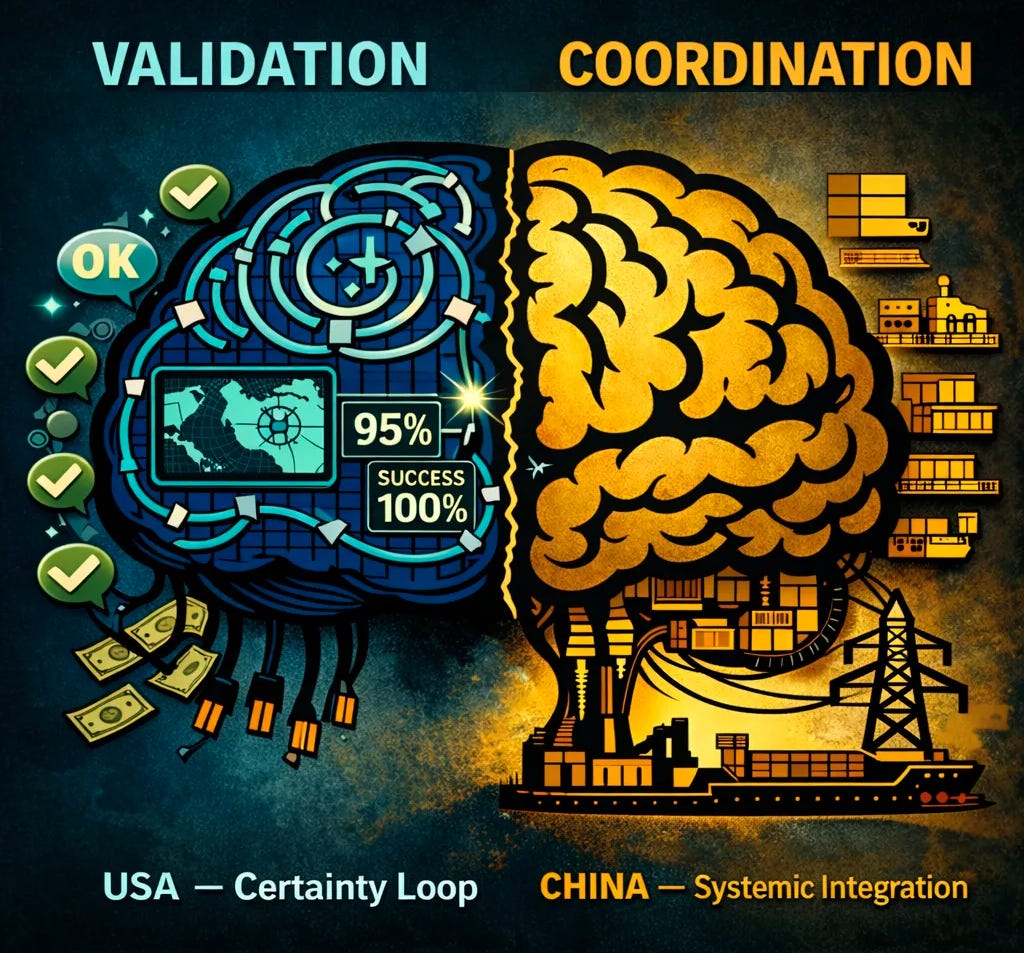
It is here that the second text takes on its full meaning. Jan Krikke shows that in the American model, artificial intelligence is conceived primarily as an autonomous capability: the goal is to build ever more powerful, faster, more generative systems, capable of reasoning, producing, and acting. This model reflects the broader logic of American capitalism: decentralised, competitive, venture-backed, dominated by the pursuit of performance and speed. It produces remarkably effective tools in certain domains, but leaves in place a strong institutional fragmentation and weak system integration.
China follows another path. There, intelligence is conceived less as autonomy than as a function: its value lies in its insertion into a larger whole, where data, infrastructure, governance, production, and circulation are designed as coordinated elements. One aims for capacity increase; the other for overall coherence.
By juxtaposing these two texts, it comes to mind that if the Iranian episode took this form, it may not be only because of command failures or a local misuse of a tool. Perhaps it is because it reveals the logic of a broader technical ecosystem: an AI developed in a world where deployment speed, demonstrative capacity, and decision-maker buy-in matter more than slow integration into real, contradictory systems.
The text on the attack on Iran says this almost explicitly when it shows models optimised for speed rather than for adversarial challenge, and decision chains compressed to the point where the fluid, structured, and confident prose of machines could override the more nuanced formulations of traditional intelligence.
An episode mentioned in the article – Millennium Challenge 2002 – gives historical depth to this phenomenon. This war game, the most expensive ever organised by the Pentagon, pitted a US force against an enemy force (a thinly disguised Iran) commanded by a retired general, Paul Van Riper. He used asymmetric tactics – motorcycle messengers, Second World War light signals, a pre‑emptive missile swarm – to sink sixteen US ships in the opening hours. The Pentagon’s response was to stop the exercise and replay it with a scripted US victory. Van Riper resigned in protest. Twenty-four years later, the same asymmetric tactics are being used by Iran – and the AI simulations, calibrated to planners’ expectations, have visibly failed to take them into account in a credible way.
AI as Mirror or as Infrastructure
This point directly connects with several analyses we published a few months ago.
In “Training or Inferring: Artificial Intelligence Reveals Two Worlds”, we proposed reading the Sino-American divide not through the sole race for models, but through the distinction between training and inference. The US appeared there as the power of training: spectacular, capital-intensive, energy-hungry, debt-backed, but weakly anchored in matter. China, by contrast, was described as the power of inference: less demonstrative, but more integrated into the real economy, into factories, networks, objects, and flows. This opposition was not simply technical; it already described two different relationships to reality.
In “The NSS 2025 Facing Reality: US AI, Chinese Matter, and the Breaking Point”, this intuition was extended. We argued that US AI increasingly functioned as a self-justifying financial narrative, while Chinese AI became a productive infrastructure, to the point that artificial intelligence no longer appeared as autonomous software, but as the very architecture of production. The formula was deliberately simple: one finances itself through debt, the other self-finances through production; one promises sovereignty through narrative, the other builds it through the integration of material supply chains.
This difference is not secondary. It helps to understand why an AI can, in one case, serve to organise matter, and in the other, to consolidate scenarios whose coherence is first and foremost discursive.
Power That Blindly Believes Its Machines
The war against Iran calls into question not only the reliability of a model and the recklessness of a command staff, but above all a decision-making regime in which the machine no longer serves as an instrument for verification, but to make things credible.
From there, the risk goes beyond a single poorly conducted war. When a power becomes accustomed to receiving from a machine formulations that reinforce its own premises, the failure of the machine affects its own authority to judge. Power then appears symbolically weakened, to the point that it may seem entirely superfluous, lost as it is in its confusion between simulation and the real world.
What is at stake is the symbolic delegation of judgment: AI becomes an alibi that excuses its users from confronting their hypotheses with the complexity of reality. Yet this delegation is not a technical inevitability; it is the product of a certain conception of intelligence – one that privileges autonomy, speed, and affirmation over integration, slowness, and contradiction.
Two Intelligences, Two Decision-Making Regimes
The question raised by these two texts extends far beyond the Iranian case. Not all artificial intelligences produce the same relationship to reality. Some reinforce, accelerate, and validate. Others connect, coordinate, and organise.
In other words, the problem is no longer only what AI can do, but what impact it has on the judgment of those who govern with it. It is from this question that the Iranian episode must be read, and it is also from it that we can understand the increasingly sharp divergence between the American trajectory and the Chinese trajectory.
The United States builds intelligences that speak to their users; China builds intelligences that speak to their systems. The former excels in producing coherent discourse and convincing projections; the latter in the silent organisation of material flows. One validates the certainties of command; the other confronts them with the resistance of supply chains.
It is not technical superiority that separates these two paths. It is a difference in decision-making regime. And it is perhaps this difference – more than computing power or number of parameters – that will decide, in the years to come, the ability to transform artificial intelligence into a true intelligence of action.