
This article is also available in French.
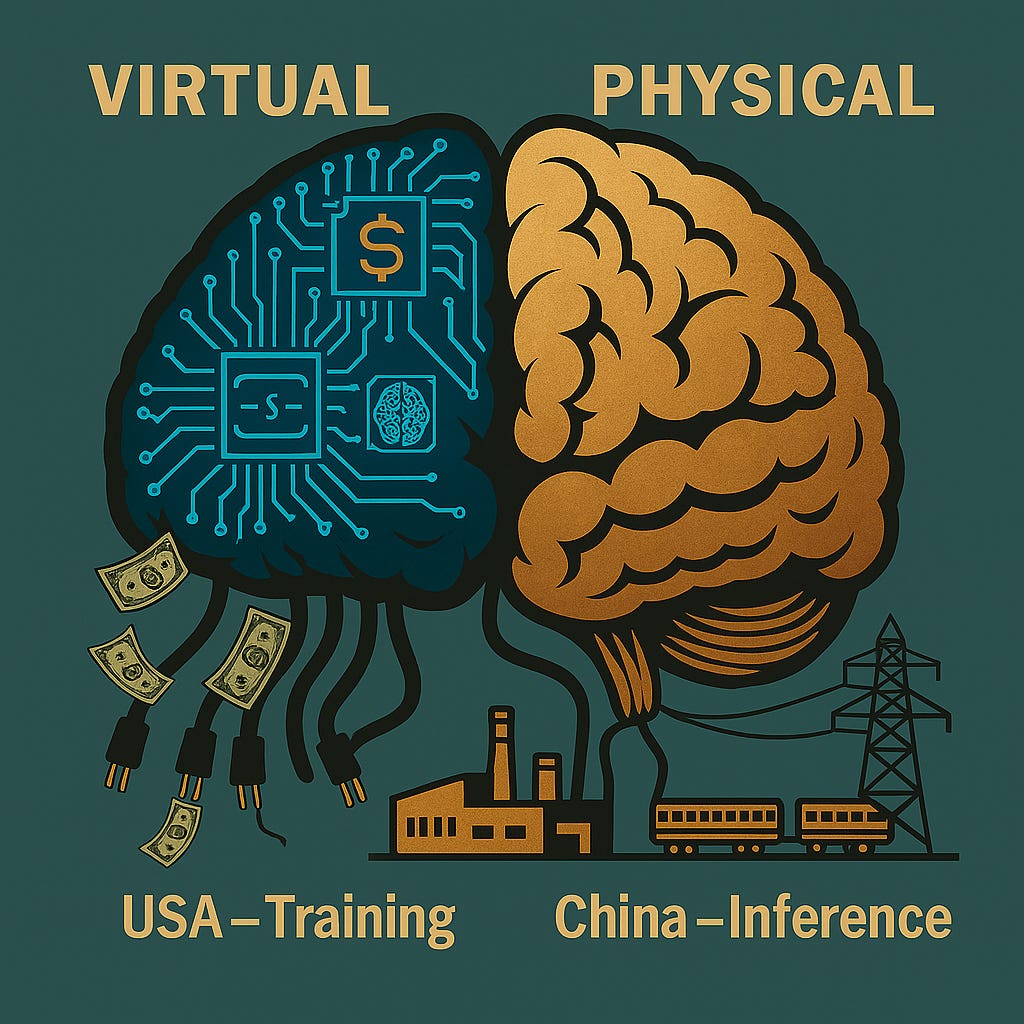
We often present the “race for artificial intelligence” as a competition of numbers: how many GPUs, how many billions, how many parameters. But the real divide between the United States and China is better understood through a simpler distinction: training and inference.
Training is the initial forge: thousands of chips aligned, mountains of data absorbed, electricity burned at the scale of a country. It is a founding act, spectacular but punctual.
Inference is everyday usage: a model already trained that answers, organizes, calculates. Less visible, but it is inference that determines whether AI truly enters the economy and society.
The United States: the fragile excess of training
Washington has chosen the path of excess. Big Tech invests hundreds of billions into “AI factories,” data centers consuming as much as a metropolis. The federal government stages this extravagance, tying it to a diplomacy of infrastructures (agreements with London, Tokyo, Abu Dhabi).
But this model rests on structural faults:
Debt and the dollar.
Everything is financed on credit, sustained by the dollar’s privilege. As with dot-coms or subprimes, the logic prepares a bubble.Industrial dependence.
Chips, modules, and servers mostly come from East Asia. Without Taiwan, Korea, or Singapore, the American digital cathedrals go dark. And Trump, paradoxically, proclaims disengagement from the Pacific.An obsolete power grid.
The American network, designed half a century ago, already buckles under climate peaks. Plugging giant data centers into it is like building skyscrapers on cracked foundations.
In short: a spectacular but unstable AI. Very powerful in the virtual sphere (finance, services, engineering), but with no direct grip on matter, lacking industry.
China: the material efficiency of inference
Beijing, after a frenzy of construction, pivoted. Constrained by American sanctions, it now bets on inference: sobriety, efficiency, integration into the real economy.
DeepSeek embodies this choice: a model ten times more efficient, designed to run with fewer resources. Huawei, with Ascend, turns embargoes into engines of autonomy.
Above all, China still holds the factory of the world. It roots AI in matter:
automating assembly lines,
optimizing ports and rail logistics,
predictive maintenance of machines,
embedding AI into consumer goods.
This is not a showcase, but an irrigation. Less spectacular, but more useful.
The ideological truth: invisible infrastructure
AI acts as a revealer of systems.
In the United States, liberalism excels at visible innovation, speculation, excess. But it fails to finance what does not pay off immediately: power grids, transmission lines, storage. Invisible infrastructure remains neglected.
In China, state capitalism assumes very long-term bets: ultra-high-voltage lines, oversized energy capacities, collective infrastructures. Even if profitability is zero in the short term, the state carries them.
This is the ideological truth:
liberalism builds showcases without foundations,
planning builds foundations that seem heavy but last.
Taiwan: the silicon shield and the countdown
Here emerges the case of Taiwan. The island lives a fragile golden age: indispensable for its fabs and its brains, but threatened by the forced relocation of its production to the United States.
Trump recently promised that half of Taiwan’s semiconductor production would be repatriated to Arizona by the end of his mandate. A thunderous announcement, but one that hides a brutal truth:
If production stays in Taiwan, conflict would render it unusable.
If it leaves, Taiwan loses its “silicon shield” and thus its strategic leverage.
In both cases, the island loses. Washington siphons off its jewels as the Kuomintang (KMT) once carried off Beijing’s gold in 1949.
The untranslatable brains
But this strategy hits a limit already noted in Taiwan, AI and the American Countdown: you cannot relocate brains like machines.
Taiwanese engineers largely refuse to settle in the United States. Those who do often return quickly, unable to adapt to a work environment without the same ecosystem or industrial discipline. TSMC’s know-how is rooted in a collective culture, not duplicable by presidential decree.
Thus, the transfer of fabs risks producing empty shells: buildings, machines, but without the human density that makes them effective. Another illusion of the “empire of steam.”
The empire of steam: the mystico-technical illusion
It is the same logic as in finance and energy: America promises infinity — limitless AI, eternal energy, growth without constraints — but stumbles on matter.
In A Grain in the Brain, we showed the empire of raw incapable of transforming.
In Cosmic Stonehenge of Finance: America’s Electric Shamanism of the Limitless Economy, we described the electric shamanism that projects eternity but hides deindustrialization and debt.
Today, in AI, the same mechanism repeats: a spectacular flight forward, without a material base.
And tomorrow: Africa and the emergents
Between these two models, others will invent.
Africa, already a land of bricolage and ingenuity, gains access to American tools of conception (virtual AI) and Chinese objects (material AI). The hybridization of both promises local revolutions.
South Asia and Latin America will follow similar paths.
The next rupture may come from there: not from American gigantism or Chinese planning, but from unpredictable hybridization.
Conclusion
The “race to AI” is not a straight line. It is a revealer:
The United States, champion of training, builds fragile illusions: indebted, dependent, plugged into obsolete grids, incapable of relocating brains. Its power is spectacular but volatile.
China, champion of inference, integrates AI into matter through industry and planning. Less flamboyant, but more resilient.
Between the two, the emergents tinker and détourne. For AI, like soy or oil before it, circulates: raw American, refined Chinese, reinvented elsewhere.
And perhaps the real shift will be played here: in the passage from virtual to material, from speculative to collective, from fragile centers to inventive margins.