

Version originale en français - Versión española

The moment when fakes cease to be exceptional
For a few weeks now, YouTube channels have been appearing and growing rapidly by featuring well-known international analysts in long, coherent, technically credible, and embodied video formats. These channels do not reuse existing interventions, do not translate previous conferences, and contain no explicit signals of fiction or simulation. They produce original content, implicitly attributed to real people who are not the authors.
The phenomenon is distinguished by several converging characteristics. First, its speed: some channels are created ex nihilo and reach several thousand subscribers within days or weeks, with significant view counts. Second, its industrial coherence: homogeneous visual identity, regular publishing schedule, structured scripts, offered transcripts, active monetization. Finally, its precise targeting: the figures used are analysts already identified by the public, associated with clear, recognizable positions, and possessing pre-existing symbolic capital.
Detection of this content is not performed by the ordinary public. Comments generally do not signal any particular anomaly. The discourses are received as plausible: consistent with what these analysts usually say and compatible with audience expectations. Doubts emerge elsewhere: among attentive listeners, based on secondary details (inconsistent figures, atypical phrasing), or among the individuals concerned themselves, forced to publicly signal the existence of videos they never produced, such as Emmanuel Todd via his Substack account1.
One central point: these videos are not distinguished by being obviously fake. They rely neither on blatant falsehoods nor on spectacular ideological reversals. The content is, overall, factually defensible and narratively aligned with the known positions of the imitated figures. What is false is not the statement taken in isolation, but the attribution of the statement.
The recent nature of the phenomenon is decisive. Attempts at intellectual deepfakes existed before, but they remained marginal, technically imperfect, or economically non-viable. What is changing today is not the existence of the technology as such, but its scaling: sufficient quality, reduced marginal cost, seamless integration into the platform ecosystem, and rapid profitability.
This set of indicators allows us to speak not of isolated experiments, but of a threshold being crossed. An activity that was until now costly, risky, and visible becomes banal, reproducible, and discreet. It is this shift, more than the technology itself, that deserves to be analyzed.
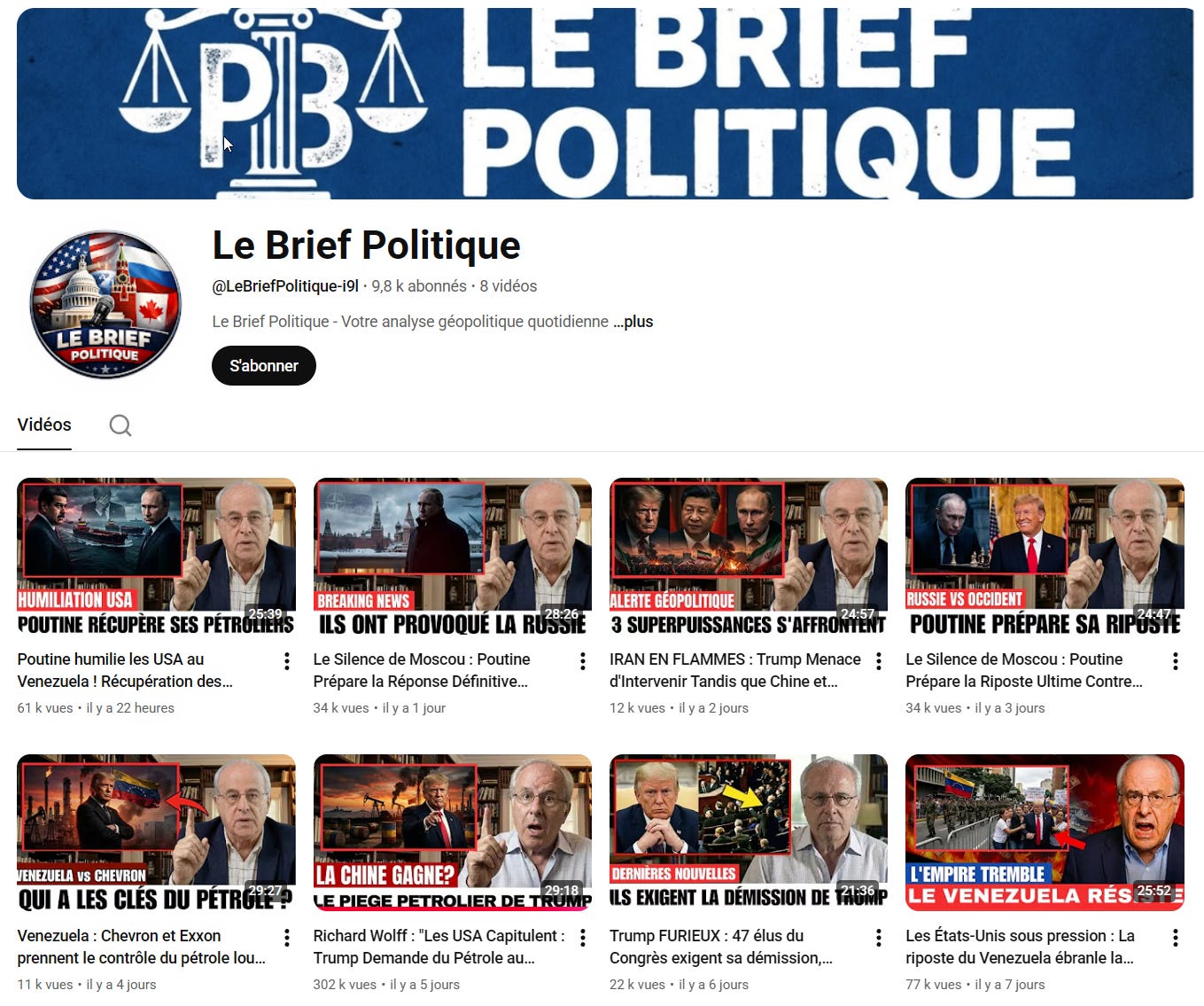
An example helps concretely illustrate this shift. A recently appeared French-language channel, Le Brief Politique, features the American economist Richard Wolff in long, structured, embodied videos. The content corresponds to no existing intervention, is not a translation of previous conferences, and has never been claimed by the person concerned.
Yet the discourse is coherent with his public positions, both in substance and tone. This is precisely what makes identification delicate. The falsification does not appear in the general argumentation, but in secondary details, questionable orders of magnitude, absence of precise sources, and above all in the impossibility of finding an original version.
This case is not exceptional. It is representative of a series of channels that appeared very recently, based on the same principle: plausible speech, attributed to a real figure, produced autonomously.
Why this content passes: narrative orthopraxy is easy to reproduce
If these productions are rarely identified as artificial, it is not due to exceptional technical sophistication, but because they fit into an already stabilized discursive framework. The videos reuse familiar narrative patterns, expected arguments, and a tone consistent with what the audience associates with the imitated figures. They do not surprise, deviate, or break.
The concerned analysts have occupied an identifiable place in the media space for several years. Their speech is associated with recurring themes, relatively constant positions, and a recognizable style. This stability facilitates recognition, but it also makes reproduction possible. The discourse becomes predictable without being trivial, structured without being rigid, which constitutes particularly favorable ground for automatic generation.
The functioning is analogous to that observed in many contemporary media formats, whether mainstream or alternative. Information is transmitted less as a series of facts than as an immersion in a language. Expressions recur, oppositions are reactivated, interpretative frameworks are carried over from one episode to the next. The public does not come seeking rupture or discovery, but continuity.
In this context, the fake does not shock because it adopts the expected forms of the narrative. It introduces neither ideological dissonance nor frontal contradiction. It inserts itself into an already known set, whose codes it embraces. Credibility stems less from the precision of the statements than from their conformity with a pre-existing expectation.
Detecting falsification traditionally relies on identifying errors, inconsistencies, or manifest divergences. Yet here, the discourse is “correct” in the narrative sense. It corresponds to what one expects to hear. Potential anomalies are marginal, quantitative, or stylistic, and do not challenge the whole.
This mechanism explains why individual vigilance is largely ineffective. As long as the content respects the orthopraxy (the expected uses) of the role attributed to the analyst, it fulfills its function. The problem, therefore, is not due to particular public gullibility, but to a discursive environment where repetition and conformity have become implicit criteria of validity2.
Under these conditions, automatic generation does not create an exogenous artificial discourse. It extends an already existing speech regime, whose contours are clear enough to be reproduced smoothly. It is this continuity, more than the technology itself, that allows the fake to circulate without apparent resistance.
The decisive role of media stardom
The very possibility of these productions relies on a prerequisite: the existence of figures already established in the media space. The imitated analysts are not chosen at random. They have sufficient visibility, an identifiable face, a voice associated with a stable intellectual posture, and an already constituted audience. In other words, they have become landmarks.
This process is not unique to alternative media. It results from a general logic of platform functioning, which favors personalization, recurrence, and embodiment. Speech is indexed to individuals more than to arguments, to figures more than to reasoning. Gradually, the analyst ceases to be perceived as a producer of situated and evolving thought, becoming instead a recognizable position in a given discursive landscape.
As this recognition settles, speech stabilizes. Not because the analyst stops thinking, but because the media environment values consistency, continuity, and fidelity to a role. Deviations, hesitations, or revisions are penalized by loss of audience, loss of subscribers, or rupture with public expectations. The figure solidifies, not out of dogmatism, but by adaptation to the framework.
This transformation is central. A thought in motion is difficult to reproduce mechanically. A stabilized posture, on the other hand, becomes modelable. Media stardom thus provides ideal raw material for automatic generation: a recognizable signature, associated with a set of themes, tones, and expected reactions. Notoriety becomes symbolic capital independent of its holder’s actual presence.
This is why substitution is not experienced as a rupture. The public does not follow a person in the strict sense, but a narrative function. As long as this function is assured, even by an artifact, the reception experience remains unchanged. The fake does not replace a singular thought; it occupies an already defined place.
It would be erroneous to see this as an individual moral failing. Media stardom is a structural condition for visibility in the platform ecosystem. But it produces a side effect: the more a figure becomes central and identifiable, the more replaceable they become. The recognition that protects against erasure protects poorly against substitution.
This point helps understand why the observed phenomenon does not affect all content producers indiscriminately. It primarily targets those whose speech has already been transformed into a stable landmark, a recognizable role, a personal brand. It is these figures that automatic generation can exploit immediately, without preliminary construction work.
The economic shift: why now?
It would be tempting to interpret the appearance of these channels as the product of an ideological intention or a manipulation strategy. Nothing requires this reading. The observable elements point to a simpler, more banal logic: that of an economic model that has become viable.
For a long time, producing credible embodied content by artificial means remained costly. Generating natural voices, lip synchronization, visual coherence over long formats, and production stability required technical and financial resources incompatible with large-scale exploitation on platforms like YouTube. The fake existed, but it was marginal, artisanal, or experimental.
What has changed recently is the crossing of a threshold. The marginal cost of producing a video becomes low enough to be absorbed by revenue generated by advertising, subscriptions, and recommendation mechanisms. From this moment, the question is no longer one of technical possibility, but one of optimization. The fake ceases to be a risky bet and becomes a profitable activity.
This evolution cannot be explained by a single factor. Generative AI offerings developed in the USA (Gemini, ChatGPT, Grok…) have, since 2024–2025, gradually lowered their entry barrier. Text, voice, or image generation services have become more accessible, notably via subscriptions or integrated packages aimed at creators. However, this movement remains constrained. The American economic model remains based on value capture per client and high-margin uses. The most performant solutions remain relatively costly and designed for solvent actors, whether institutional or professional.
Simultaneously, other actors have appeared with a different logic. Recent Chinese offerings in generative AI, particularly in the multimodal domain, prioritize less maximum excellence than functional sufficiency at large scale. The objective is not to produce perfect artifacts, but content sufficiently credible for mass use, at compressed costs. This difference in model, volume versus rent, is decisive for understanding the emergence of a grey market for synthetic speech.
This evolution coincides with the stock market listings, in Hong Kong, of several Chinese companies specializing in generative artificial intelligence. Companies like MiniMax or Zhipu AI3 raised significant amounts in late 2025 and early 2026, explicitly positioning themselves on multimodal services (text, voice, image, and video) intended for mass use4.
The products promoted by these actors, such as HailuoAI, Talkie , or MiniMax’s video and voice generation models, do not aim for maximum perfection, but for sufficient quality for common uses, at heavily compressed costs, and aimed at the general public. This approach is consistent with a logic of broad diffusion and profitability by volume, rather than by scarcity.
It is neither necessary nor possible to establish a direct link between these channels and specific providers. What matters is the conjunction of dynamics. On one side, tools that have become good enough and cheap enough. On the other, a perfectly tuned platform ecosystem for monetizing repetitive, embodied, and engaging formats. Between the two, an economic space opens, without the need for ideological intention or central coordination.
This shift is very recent because it depends on the convergence of these factors. The technologies existed before, as did the platforms and the media figures. What was missing was the alignment of costs, uses, and revenues. Once this alignment is reached, substitution becomes not only possible but rational.
In this sense, the observed phenomenon is not an anomaly. It corresponds to a classic adjustment in the platform economy: when a process can be automated without immediate loss of perceived value, it eventually is. Embodied speech, once stabilized and monetizable, does not escape this logic.
The silent role of platforms
The development of this content would not be possible without a perfectly adapted dissemination environment. Video platforms, and YouTube in particular, are not neutral vectors. They constitute the economic infrastructure that makes the operation viable, without having to intervene actively.
The formats concerned correspond precisely to what algorithms favor: long, embodied, regular videos, fostering audience loyalty and stable engagement. The subjects addressed, often geopolitical or analytical, generate attentive and repeated consumption, compatible with advertising monetization and subscription mechanisms. In this framework, the platform has no structural interest in distinguishing authentic from synthetic, as long as performance indicators are satisfactory.
Editorial responsibility is thus shifted downstream. Reporting mechanisms exist, but they rely on the initiative of the concerned individuals or users. There is no systematic upstream filtering, nor any mechanism to verify the identity of the speaker for this type of content. The authenticity of speech is not part of the eligibility criteria for dissemination or monetization.
This functioning is not the result of an explicit ideological choice. It stems from the very logic of platforms, designed to maximize volume, viewing time, and publication regularity. The distinction between embodied and simulated speech is not relevant in this framework, as long as the user experience remains fluid and retention is assured.
This structural silence produces a cumulative effect. The more this content circulates, the more it normalizes its own existence. The public becomes accustomed to speech detached from any guarantee of origin, without this constituting an immediate obstacle to consumption. The platforms, for their part, benefit from an expanded supply, inexpensive to produce, perfectly compatible with their economic models.
The result is a self-sustaining system. Producers of synthetic content do not need institutional visibility or formal recognition. They merely need to insert themselves into expected formats and respond to algorithmic signals. The platform, in return, ensures dissemination and monetization, without having to rule on the question of authenticity.
This passive yet determining role explains why the phenomenon meets no structural resistance. It is not a punctual failure, but an alignment of interests. As long as speech, whether human or synthetic, remains compatible with performance metrics, nothing incentivizes platforms to introduce frictions likely to reduce the flow.
A true speech without an author
The difficulty posed by this content does not primarily lie in its factual veracity. In many cases, the analyses proposed are coherent, informed, and compatible with the state of available knowledge. They do not rely on crude inventions nor on manifest ideological reversals. This is precisely what makes them difficult to identify as artificial.
The problem lies in the enunciation: these discourses are implicitly attributed to real people who did not produce them. This is not a lie in the classical sense, but a usurpation of speech. The content can be defensible in isolation, while being inauthentic in its source.
This dissociation between the truth of the statement and the identity of the speaker constitutes a major shift. Traditional vigilance mechanisms rely on fact-checking, source confrontation, or analysis of intentions. Yet here, these tools are largely inoperative when there is no false fact to correct nor aberrant thesis to refute. The flaw lies in the attribution itself.
In this new regime, truth becomes partly fungible. A plausible line of reasoning can be held by any enunciator as long as its form, style, and narrative framework correspond to expectations. The author ceases to be a necessary condition for the perceived validity of the discourse. They become a mere symbolic support, interchangeable.
This evolution is not unique to AI. It prolongs a movement already underway, in which public speech is increasingly evaluated based on its conformity to a role rather than the singular experience of the enunciator. Automatic generation merely exploits this transformation, pushing to its conclusion the logic of dissociation between content and responsibility.
The result is a paradoxical situation: the more a discourse is reasonable, expected, and aligned, the more easily appropriable it becomes. Singularity, hesitation, internal contradiction (all elements characterizing a living thought) become obstacles to reproduction. Conversely, stability, consensus, and repetition facilitate substitution.
This shift explains why the question posed by this content cannot be reduced to a debate about disinformation. What is at stake is not the circulation of the false, but the possibility of a speech that circulates without an identifiable author, without explicit responsibility, and without anchorage in a real intellectual trajectory.
What still makes a speech non-substitutable?
The recent emergence of artificially embodied channels stems neither from a sudden technological rupture nor from a coordinated ideological project. It corresponds to an economic adjustment in an environment already structured by media stardom, narrative repetition, and algorithmic monetization.
When speech becomes predictable, stabilized, and profitable, its mechanical reproduction ceases to be a technical problem and becomes a rational option. AI does not introduce a logic foreign to this ecosystem; it simply reveals its end points.
The observed phenomenon does not herald the disappearance of human speech, but its competition with synthetic forms capable of occupying the same spaces, at lower cost and without constraints of responsibility. The question, therefore, is not that of the truth of the discourses, but that of the conditions under which a speech can still be attributed, situated, and assumed.
In the long run, this shift forces us to re-ask a simple question: in a system where conformity is rewarded and singularity penalized, what still makes a speech non-substitutable?
Notes
Substack, Emmanuel Todd, Beware of "deepfakes", January 14, 2026
Substack, François Vadrot, From Dissident Commentary to Hypnotic Series, September 7, 2025.
Nikkei Asia, Loretta Chen, Alibaba-backed AI startup MiniMax raises $618m in HongKong IPO, January 9, 2026.
Nikkei Asia, Loretta Chen, China AI, chip companies raise billions in Hong Kong amidtech rivalry, January 13, 2026.