
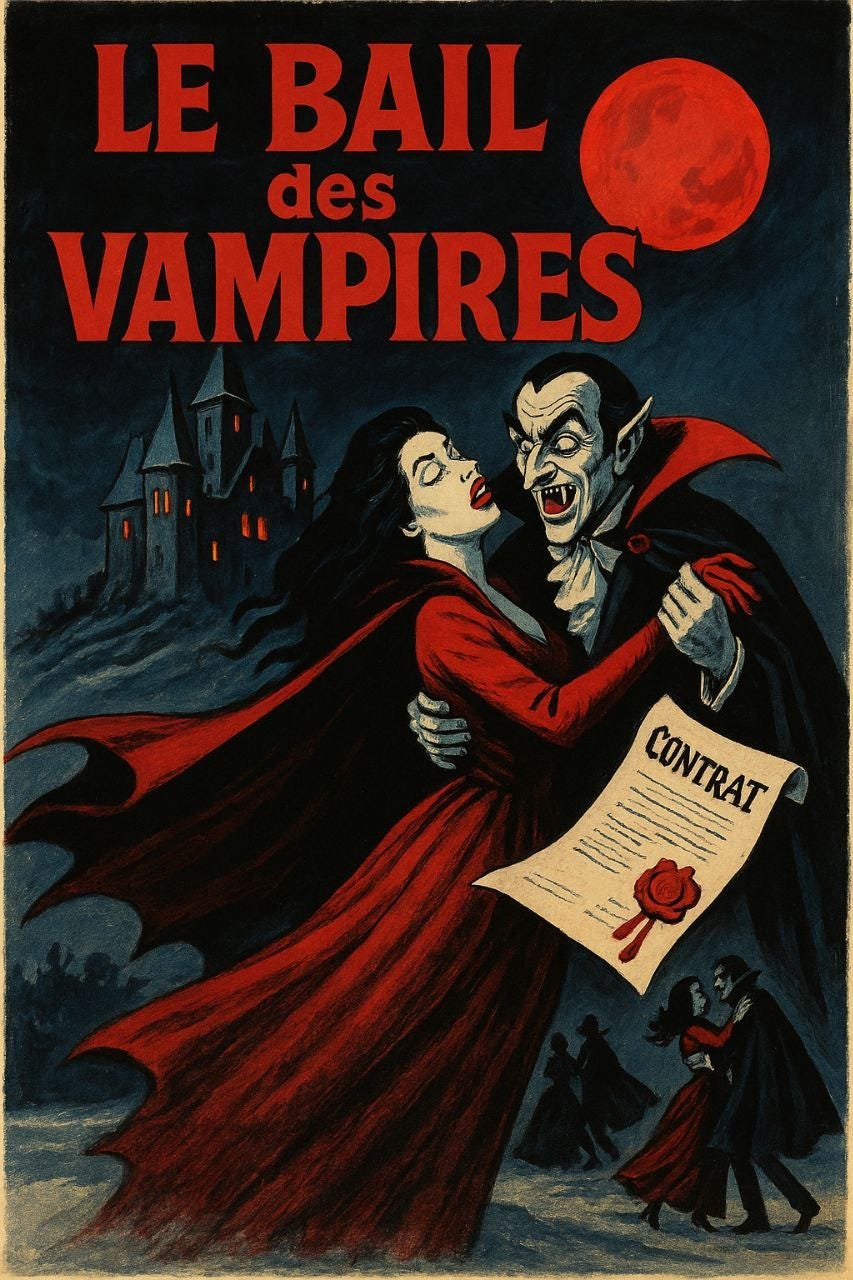
They say that in the high towers of the West, a vampire has ruled for generations.
His power does not lie in the virtue of his own blood, but in his ability to drain that of others.
Every century, he invents a new way to prolong his reign: wars, treaties, promises, debts.
Always the same mechanism—drink without ever giving back.
But the vampire has aged. His thirst has become insatiable. His cellar overflows with ledgers filled with red numbers, debts no human life could ever repay. So he has imagined a new trick: offering his subjects contracts that last a hundred years—so-called “century bonds,” debt obligations that will not mature until 2125 or beyond.
“You will give me your blood, and I will hand you a parchment. In one hundred years, you will be paid.”
As if time could be deceived, as if the eternity of paper equaled the reality of spilled blood.
His prey are well known: the vassals, the old allies. Japan, trembling yet obedient; Europe, believing itself free while baring its neck; Britain, proud of still carrying the marks of the bite. They know the pact is unequal, but they prefer the slow drain to sudden abandonment. So they yield, again and again, whispering that perhaps one day the vampire will protect them from darker terrors.
The enemies, meanwhile, no longer allow him near. China, Russia, and others hold crucifixes made of gold and oil. They watch the vampire’s feasts from a distance, waiting for the moment when his victims, drained of their substance, finally realize he has nothing left to offer.
And as the banquets go on, the vassals wither. Their wealth evaporates into century-old parchments, their peoples grow poorer, their illusions fade. Yet they still repeat: “Better to be drained slowly than to die alone.”
But everyone senses the pact cannot last forever. The vampire’s survival depends on victims growing weaker. And when they can give no more, when their veins yield not a single drop, what will become of the master of the high towers?
The vampire lives longer than his enemies hoped. Yet every bite, every century bond, every forced debt brings his empire closer to its end. For a vampire cannot survive indefinitely in a world where the prey begin to open their eyes and seek other shelters.
The vampires’ lease is nothing more than another name for his slow agony.
Author’s Note:
In French, the original title « Le bail des vampires » is a pun on Roman Polanski’s 1967 film Le Bal des vampires (The Fearless Vampire Killers). The word bal (“ball,” a dance) is swapped with bail (“lease”), turning a vampire ball into a vampire lease—linking Gothic cinema with century-long debt contracts.