
Also available in French, Spanish, and Brazilian Portuguese.
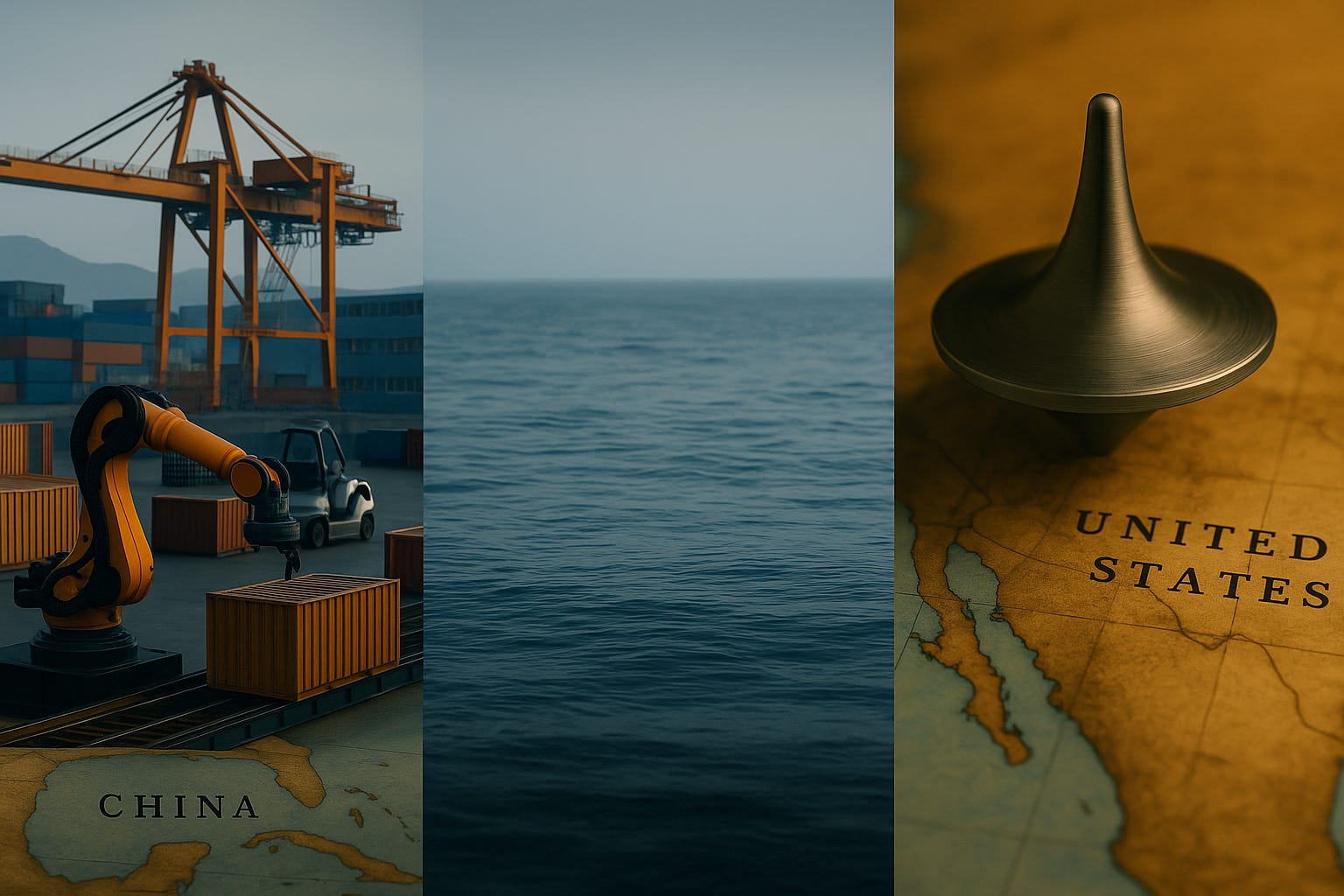
Everything turns, yet nothing comes out. American artificial intelligence has invented its own circular economy: Nvidia funds OpenAI, which buys its chips; Microsoft pours billions into the same company, then recovers its licenses through the Azure cloud; AMD and Oracle build data centers that others will finance in order to use them. The choreography looks perfect: each actor supports the other, contracts follow one another, balance sheets swell. But this ballet is not industrial—it is financial theater. AI produces nothing; it produces itself.
American analysts describe this loop as a marvel of efficiency and end up taking part in the same movement. They question, worry, respond, encourage one another, and in unison confirm what they claim to examine. The suspicion of a bubble becomes a sign of vitality. Commentary becomes fuel. The economy and its narrative spin together, at the same rhythm, two gears that enchant each other.
The most fitting image is that of the spinning top: stable as long as it spins, absurd as soon as it stops. The AI economy consumes belief to produce promise. What it sells is not intelligence, but faith in its imminence.
Beneath the spinning top, however, lies the earth—and that earth is no longer American. OpenAI’s chips are etched in Taiwan, their wafers Japanese, their metals Chinese, their magnets Mongolian. The most dematerialized economy in the world rests on ports, mines, and cargo. The more Silicon Valley speaks of autonomy, the more it depends on the other side of the Pacific. America spins on itself, but its axis is Chinese.
While the top hums, China moves forward. There, intelligence is not a finished product but a tool. It optimizes logistics, regulates energy flows, refines maintenance, manages cities. Each algorithm serves something—often someone. It is not an economy of promise but of continuity: computation extends matter; it does not replace it.
Europe watches. It regulates what it does not produce, consumes what it no longer understands, and adopts American models as it once adopted their office software—out of habit. No loop, no anchor: only the conformity of a continent turned market.
Thus the fracture emerges: on one side, America of belief; on the other, China of use. Between them, the ocean—smooth surface where promises and cargo cross paths.