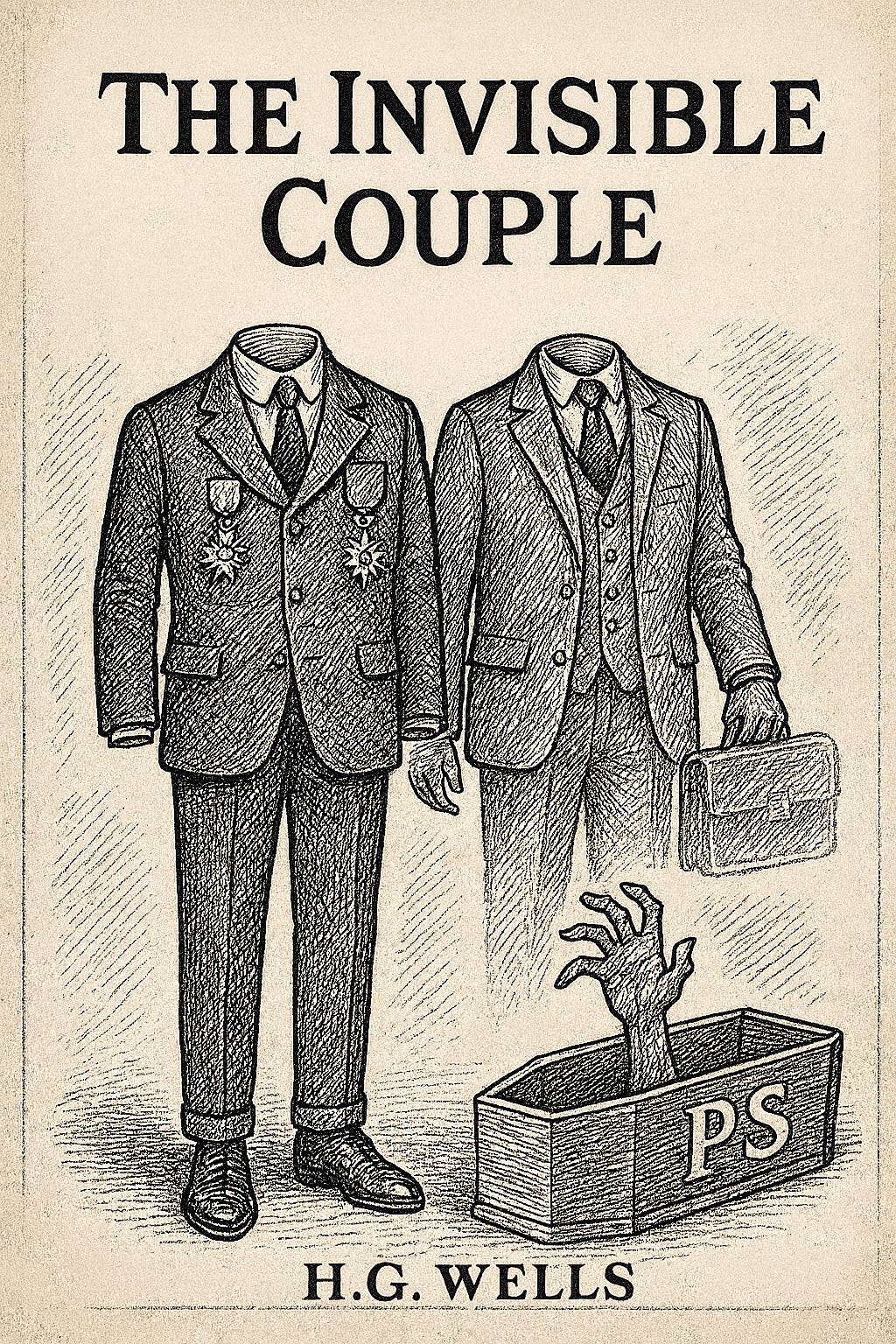
A Victorian-style parody: Macron and Lecornu as silent phantoms, a people shouting at emptiness, and the Socialist Party reduced to the undead.
Prologue
(From a manuscript found in an old leather trunk, dated 1897, and attributed to an anonymous witness of the French capital.)
“This is a strange tale that I undertake to set down here, and I beg the reader to suspend for a moment his incredulity. For there was a time when, in the neighbouring kingdom of France, the supreme authority withdrew from the sight of men. Not merely in a metaphorical sense, but with such rigour that the multitudes, gathered in the streets, shouted against emptiness and hurled their imprecations toward a deserted throne.
I was assured that there were two who reigned: the one, master of the Élysée, stood mute as a statue of marble; the other, head of the Council, had discovered the means of withdrawing entirely from human gaze. They were soon named, not without irony, the Invisible Couple. And this name became common, for it expressed most aptly the strange sensation of a nation governed by phantoms.
Meanwhile, the squares and boulevards filled with workmen, teachers, women, students, holding aloft placards on which one could read: Tax the rich, Abolish privileges, or even, in a more vulgar idiom: The trickle does not trickle down at all. The people, they said, demanded fiscal justice, and no visible power deigned to answer.
It was then that a rumour circulated, in salons as well as in taverns, of a chemical process — a formula from some English physicist — which had allowed this singular couple to escape the light, in order to reign unseen. Was it miracle? Was it curse? I myself collected, in those days, the testimony of two gentlemen who, claiming to have approached the affair at close hand, conversed gravely upon the mystery.
It is their words that I now report, faithfully transcribed, for the edification of future generations.”
First Scene – In the Smoking Room of Mr W.
On the 21st of September in the year 1897, in the smoke-filled parlour of a club on the right bank, two gentlemen — whom I shall designate by their initials only, Mr H. and Doctor R. — conversed at length upon a phenomenon which was then the talk of the whole capital.
Mr H.
— Doctor, you are a man of science; enlighten my lantern. They say in Paris that a certain couple governs the Republic whilst remaining invifoccusible. I find it hard to believe: how can such personages exercise authority if they never show themselves?
Dr R.
— Yet the matter is assuredly true. One, the President, holds himself mute; the other, the Prime Minister, effaces himself to the point of transparency. The people have ended by saying: the first is mute, the second invisible. This phrase is repeated from mouth to mouth, as though power itself had taken refuge behind a curtain of shadow.
Mr H.
— Ah! what a singular prodigy. I myself observed, last Thursday, a multitude of demonstrators upon the great boulevards. Their placards bore inscriptions couched in a language scarcely academic: Tax the rich!, Abolish privileges!, and even — pardon me the vulgar expression — The trickle does not trickle down at all. It was like the coarse translation of an economic thesis.
Dr R.
— You touch there upon the very heart of the mystery. For these gatherings were by no means scanty: according to the authorities, five hundred thousand souls; according to the syndical leaders, more than a million. These two figures are irreconcilable, yet in either case they far surpass the peaceful capacity of our boulevards. And what did the Invisible Couple do? Nothing. No word, no appearance.
Mr H.
— Nothing? Not even a declaration?
Dr R.
— The task was delegated to Matignon, but Matignon itself hid behind the curtains. The President walled himself in silence, the Minister effaced himself. They resembled two statues of salt. Meanwhile, the oppositions and the syndicates, like mischievous children, seized the stage left vacant.
Mr H.
— But then, who governs?
Dr R.
— That is precisely the question. An editorialist has lately affirmed that this new Prime Minister could, at best, attempt to lower the pressure so that the wave of dégagisme should not sweep away everything. You will agree that such is a most inglorious rôle for the head of government.
Mr H.
— To lower the pressure… like loosening the safety-valve of a boiler on the verge of bursting. But if the boiler be left to itself, is not the explosion inevitable?
Dr R.
— Your comparison is exact. Moreover, the forces of order were mobilised in mass: eighty thousand policemen and gendarmes patrolled the arteries to contain the crowd. One hundred and eighty persons were arrested, silhouettes among so many others, whilst power itself remained untraceable.
Mr H.
— It is then a Republic governed by phantoms. See, Doctor, it gives me chills: a power without a face is already a tyranny without a body.
Dr R.
— Or a scientific prodigy, depending on the angle one adopts. Some affirm it to be the work of chemistry, a kind of serum invented by a British physicist. Others say that invisibility is nothing but a tactic, a political calculation: to withdraw from sight in order to escape the hisses of the crowd.
Mr H.
— But surely, Doctor, every savant knows that invisibility, far from being a shield, becomes sooner or later a burden. He who does not show himself already ceases to exist.
Dr R.
— You anticipate my very thought. The people, weary of railing against emptiness, may well turn their wrath against the very substance of the State. For to govern without appearing is to expose oneself to be no longer recognised.
Mr H.
— Then, Doctor, do you believe the Invisible Couple can long reign?
Dr R.
— History shall teach us. Yet I can assure you of one thing: the invisibility that saves the two companions today will tomorrow condemn them to vanish altogether, as though they had never existed.
Second Scene – In the Streets of the Capital
On the following day, Mr H. and Doctor R. descended together towards the great boulevards, where the echo of the demonstrations still lingered. The paving-stones were strewn with crumpled papers, discarded placards, and dented megaphones.
Mr H.
— See, Doctor, how the tumult has left its trace. The walls still bear inscriptions scrawled in haste: Abolish privileges, The Zucman tax, now!, and this curious imperative: Tear the pockets of the rich to mend the hole in Social Security. One might think them the coarse verses of a pamphleteer at the street corner.
Dr R.
— And yet, my dear friend, these formulas are the very substance of anger. Yesterday, more than two hundred and fifty marches were set in motion across the land. In Marseille, they claimed one hundred and twenty thousand; in Toulouse, forty thousand. Here in Paris itself, the human tide filled the avenue from end to end.
Mr H.
— And all this to cry at absentees! What a strange masquerade: the crowd roars, the police contain, and power remains a spectre.
Dr R.
— I heard, among the ranks, a workman murmur: “Let them come out of the shadows! Let us see them at last!” But no face was shown. The Élysée closed its shutters, Matignon its curtains. The people disputed only with façades.
Mr H.
— Is this, then, what it means to govern? To be the master of a house whose threshold no one may cross?
Dr R.
— One might say it is a strategy. An editorialist, much listened to in parliamentary circles, affirmed that the head of government hoped only to slow the wave of dégagisme, lest it carry all before it. But what wave, I ask you, can be contained by silence alone?
A breath of wind passed along the street. A few figures lingered, flags rolled beneath their arms, continuing to converse in small groups. Their disillusion seemed heavier than their anger.
Mr H.
— Doctor, I wonder if this people are not like the villagers of the old tales: they knock upon the castle door, but find only a shadow. In time, they will believe that the castle itself exists no more.
Dr R.
— You touch the truth. A power that hides ends by dissolving. And when the governed see only phantoms, they invent other masters — visible ones, and far less merciful.
A silence fell. In the distance, the church bells tolled the Angelus. The two men gazed upon the mute façade of a ministry: a heavy door, shutters closed, a solitary guard. Everything gave the impression of a deserted fortress.
Mr H.
— If Mr Wells himself were to set down this tale, he could not invent better: a couple in power, invisible to the multitude, and crowds crying against the void. It is the very substance of the fantastic.
Dr R.
— No, my friend: it is not the fantastic, but politics. And that is perhaps the most dreadful prodigy of all.
Third Scene – The Occult Laboratory
That same evening, Mr H. found Doctor R. engaged in manipulating phials that glowed with a sinister light. The glass vessels reflected reddish gleams, and a pungent odour hung in the air.
Mr H.
— Doctor, I see you have advanced in your researches. Is this the elixir of invisibility of which men whisper the Invisible Couple make use?
Dr R.
— Precisely. Behold this flask, its label tremblingly inscribed: Tinctura Occultans1. Yet I suspect it is no mere mixture of salts and rare metals. I have detected traces of cocaine, that white powder already circulating under the cloak in certain elegant circles. More alarming still, derivatives of new alkaloids, which the apothecaries name with dread: molly, keta, even speed.
Mr H.
— Come now! You mean to say the government in its entirety runs on these potions of intoxication?
Dr R.
— I fear it is so. Taken together, these substances produce not merely euphoria and muteness, but a singular side-effect: the effacement of contours. At high doses, the subject becomes a ghost. It is no longer the scientific invisibility of Mr Wells, but chemical stupor masquerading as strategy.
Mr H.
— That casts a new light upon their obstinate silence. Our rulers are not sphinxes: they are revellers, invisible because they are high.
Dr R.
— And remark how emptiness draws revenants. See there, that shadow slipping through the laboratory: it is the old Socialist Party. They now call it the zombie party, for it wanders without substance, still agitating, though already decomposed.
A pale silhouette, with mechanical gestures, shuffled across the room, moaning hollow words about “value” and “justice”, to which no one paid the least attention.
Mr H.
— A frightful spectacle: an Invisible Couple, a zombie party, and an entire people reduced to demonstrating against spectres. If this be not a tale of horror, it is at least political farce.
Dr R.
— Indeed, my friend. And remember: the drugs that render one invisible also dissolve power itself. What was meant to mask weakness will only reveal decomposition.
Epilogue – The Manuscript Closed
Thus ended the conversation of the two gentlemen. At the bottom of the manuscript I discovered these lines, traced in a nervous hand:
“It is said that one night, beneath the gas lamps of the boulevard, certain passers-by believed they perceived two staggering silhouettes, as though effaced by the mist. One wore a collar of invisible medals, the other brandished a briefcase without substance. Witnesses swore they laughed faintly, with a broken laughter, as if under the influence of a draught too strong. Then, in a single instant, they evaporated, leaving behind them a lingering scent: a mixture of stale champagne, fine powder, and a luxury perfume too heavy to conceal fatigue.
In their place, there remained only a zombie party, chanting empty slogans in the night. It may still be heard at times, in the corridor of Parliament, muttering promises of bygone days.
Let history retain this lesson: to govern in invisibility is to consent to vanish. The people remember. The ghosts never do.”
Note on Tinctura occultans
In the context of this political satire in the manner of H.G. Wells, Tinctura Occultans — the “Tincture that Conceals” — is not a real potion but a fictional metaphor for the rhetorical and media arsenal of those in power.
It represents the toxic blend of techniques used to hide the truth, mask incompetence, or lull the public into passivity in the face of crises, scandals, and the unpopularity of reforms.
Its modern ingredients are:
– obsessive communication that drowns meaning in a flood of words;
– euphemisms that distort reality (concerns for anger, adjustment for regression);
– cosmetic announcements designed to make the last failure disappear;
– disinformation and fake news that breed confusion and opacity;
– scapegoats designated to divert attention from true responsibility.
The tale thus borrows this old alchemical formula to symbolize the modern art of manipulating perception: not turning lead into gold, but truth into obfuscation. The government appears as a sinister alchemist, whose only transmutation is to make failure invisible and illusion endure.
This tale was inspired by three articles in the electronic newsletter of the French newspaper of record, which I particularly cherish as a reference point for the rhetoric of the dominant power.
Emmanuel Macron and Sébastien Lecornu, an executive tandem remarkably discreet in the face of social anger, Le Monde, September 19, 2025
Day of protest on September 18: demonstrators between anger and disillusion, Le Monde, September 19, 2025
“Sébastien Lecornu can, at best, try to lower the pressure so that the wave of dégagisme does not sweep everything away”, Le Monde, September 17, 2025