

This article is part of the broader context of “BYD-ization,” a concept we have formalized and developed in a series of articles cited in the notes at the very end.
Preamble. In two previous articles, we proposed and then tested the concept of BYD-ization. It does not refer only to the rise of BYD, nor even to the spectacular competitiveness of Chinese manufacturers. It describes a broader mechanism: the moment when a Chinese company or ecosystem no longer merely takes market share, but redefines the very norm of a sector.
The first article formulated its eight mechanisms: vertical integration, scissor effect on competitors, acceleration of development cycles, technological substitution, use of the domestic market as a springboard, coordination with public priorities and the offering of complete systems. The second demonstrated their concrete application: Volkswagen, Renault, Nissan, Honda or Hyundai are no longer merely seeking to sell in China, but to use China as an industrial, technological and software base for the rest of the world.
This third instalment shows that BYD-ization concerns not only the battery, the platform, production cost or development speed. It enters the cabin, the screens, the voice assistants, the operating systems, the driving data and the on-board artificial intelligence. In other words, the car becomes the entry point of a Chinese software ecosystem. Behind the automobile, the war of digital architectures begins.
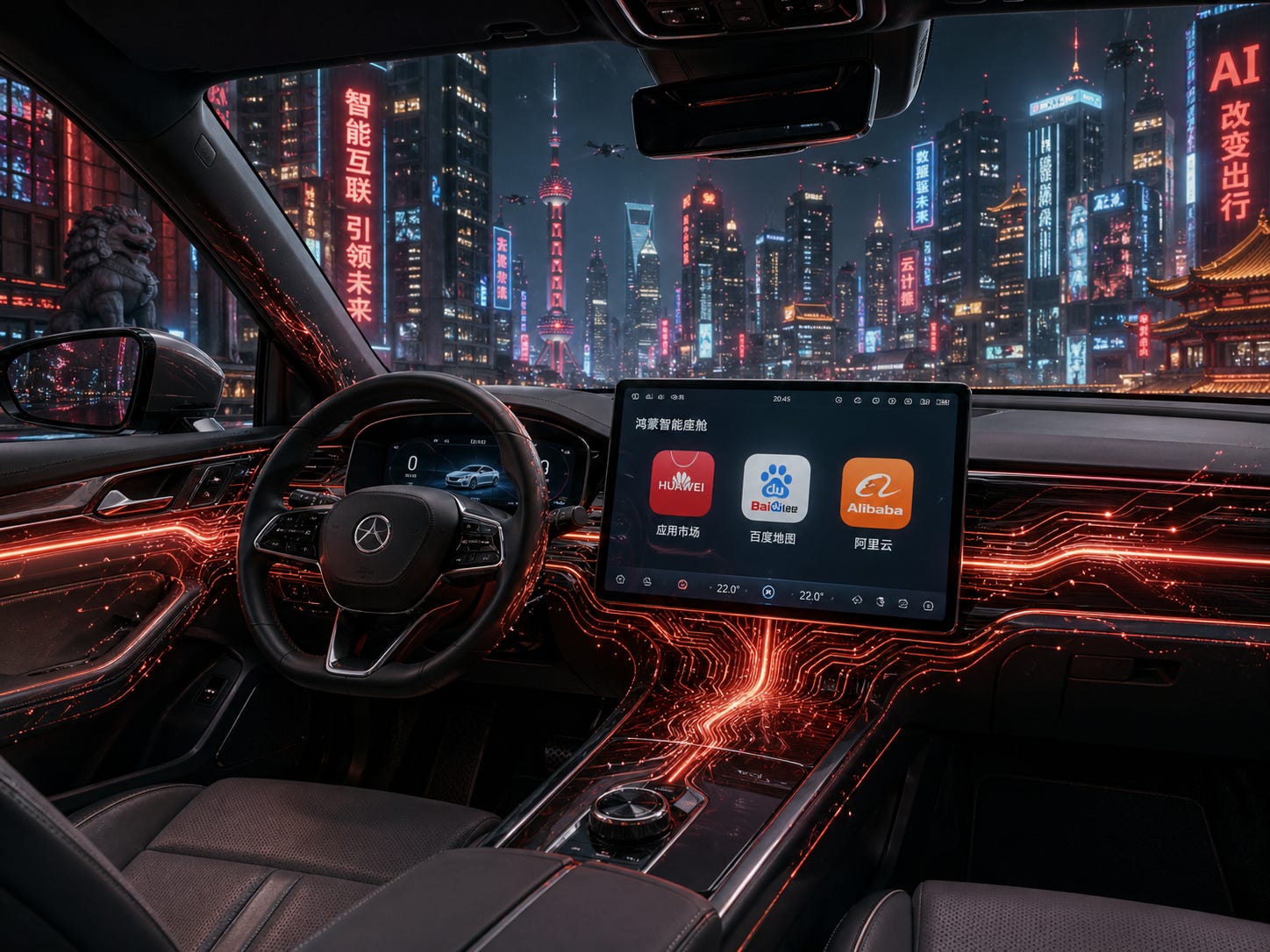
We have previously shown how BYD-ization is redefining global automobile production. But that is only the surface. Beneath the bodywork, a battle with even greater consequences is underway: that of the software ecosystem that will control cars, and soon many other objects in our lives.
For fifteen years, Apple (iOS) and Google (Android) have reigned over mobile interfaces. The connected automobile offers a new digital continent, and China is landing there with a coherent plan.
The cabin, a new bridgehead
A modern car is a screen, a voice assistant, a permanent cloud connection, and increasingly autonomous functions. Until now, traditional manufacturers subcontracted these layers to disparate suppliers, with often mediocre results. Result: drivers preferred to use CarPlay or Android Auto, leaving Apple and Google masters of the user experience.
This paradigm is shifting. Cars produced in China natively embed local technologies: Huawei voice assistant (on the Nissan Teana), seamless smartphone connectivity, autonomous driving from Momenta or Horizon Robotics. These are no longer afterthought accessories, but the native building blocks of the vehicle, optimised for a Chinese ecosystem.
For millions of new motorists in Southeast Asia, Latin America or Africa, the first contact with the “smart car” will be through an interface developed in China, on a Chinese operating system, linked to Chinese cloud services. The automobile becomes the gateway to ecosystem loyalty, as the smartphone was for iOS and Android.
And this ecosystem is not limited to the private car
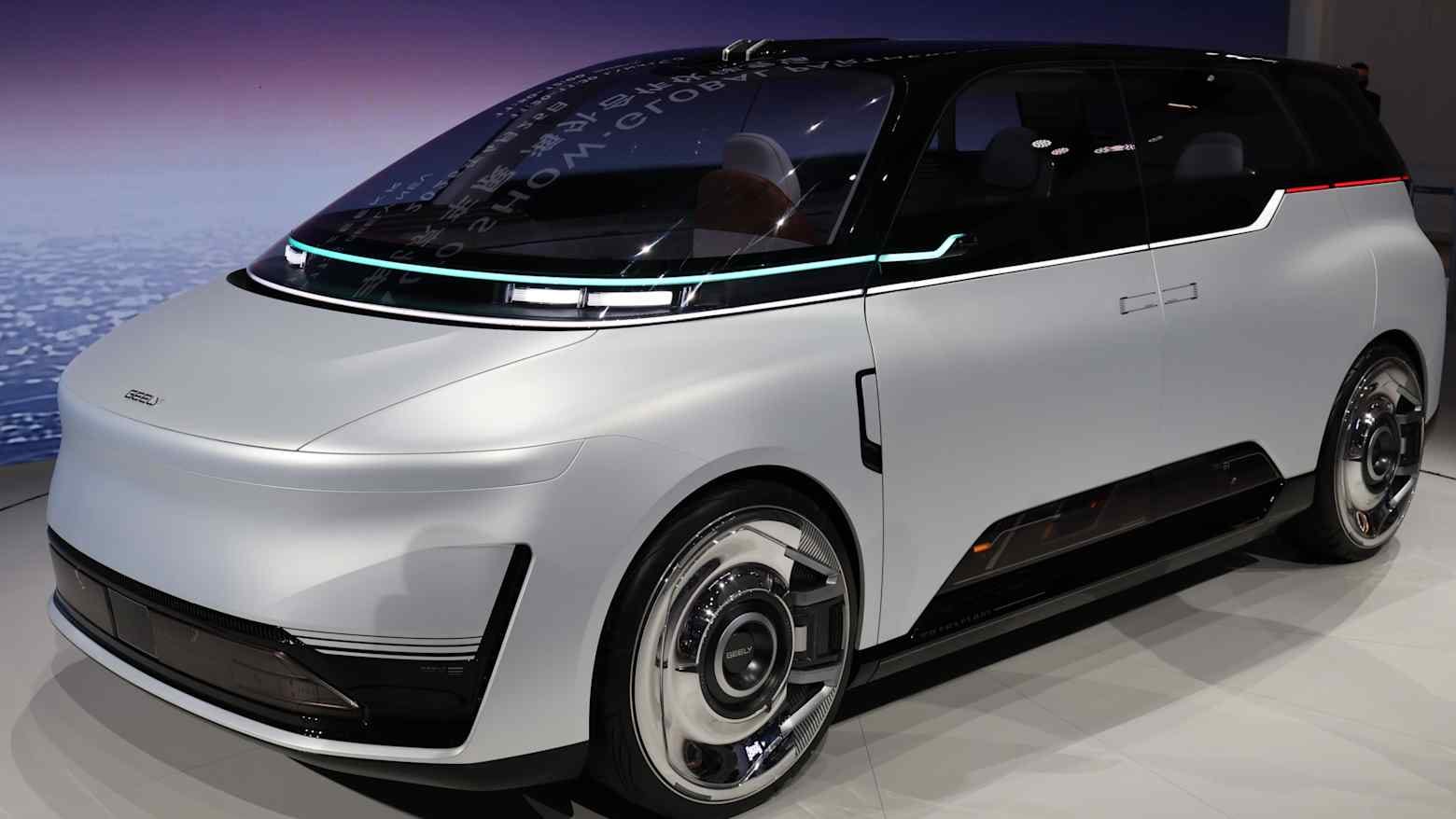
A Nikkei Asia article from 26 April reveals that Chinese manufacturers are launching an assault on the robotaxi market. Xpeng, whose chips and autonomous driving know-how Volkswagen now uses, already equips its GX SUV with level 4 capabilities and plans to deploy a robotaxi fleet as early as this year. Geely unveils its Eva Cab prototype and announces, via its Caocao service, 100,000 driverless taxis worldwide by 2030. These vehicles are not simple cars equipped with a voice assistant: they are complete autonomous systems, connected to Chinese clouds, integrating mapping, perception, decision and control. The software ecosystem no longer merely assists the driver, it replaces them.
HarmonyOS, the chameleon OS
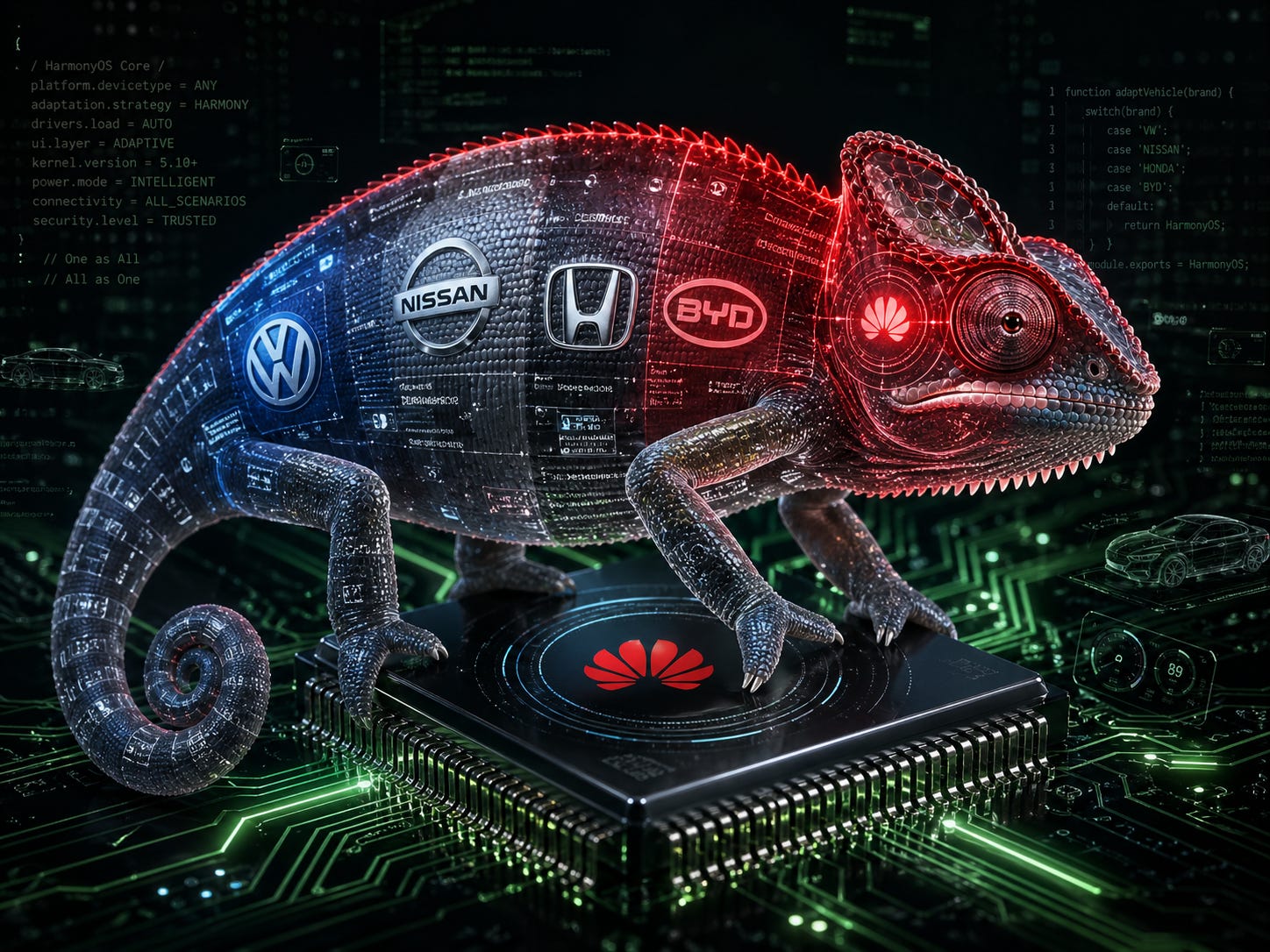
Huawei, banned from Google services since 2019, did not build an ersatz Android with HarmonyOS. It built an operating system designed to run on a multitude of terminals: watches, televisions, home appliances, and especially automobiles. Unlike Android Auto or CarPlay, which project a limited extension of the smartphone onto the car’s screen, HarmonyOS aims for native integration. The car communicates directly with other devices in the home, shares data in real time, receives coordinated OTA (over-the-air) updates.
The model recalls Apple’s, but with a major difference: Huawei licenses its system to other manufacturers and equipment suppliers. HarmonyOS can thus become the “Android of the automobile”, without the fragmentation that long handicapped Android, because it remains controlled by a single player, backed by a state – an advantage of Chinese State Capitalism.
Several Chinese brands have already adopted it. The Nikkei article notes that Nissan is using Huawei’s voice assistant; this is only a first step. If HarmonyOS were to natively equip exported Nissan models, the Chinese software standard would spread under a Japanese banner, blurring geopolitical lines.
And the movement is accelerating: Seres, Huawei’s partner, has just presented a new technological architecture promising vehicles equipped with “level 4 embodied intelligence” – in other words, an AI that physically controls the car and can drive it without human intervention in predefined conditions. Huawei’s OS no longer merely displays maps and menus: it takes the wheel.
BYD, for its part, confirmed on 27 April that it is in discussions with Formula 1 to test its electric technologies. Motorsport becomes a laboratory for the Chinese ecosystem, a global showcase intended to prove that Chinese batteries, software and engines can dominate motorsport as they are beginning to dominate the market.
This does not only concern luxury electric vehicles, but also cheap petrol models
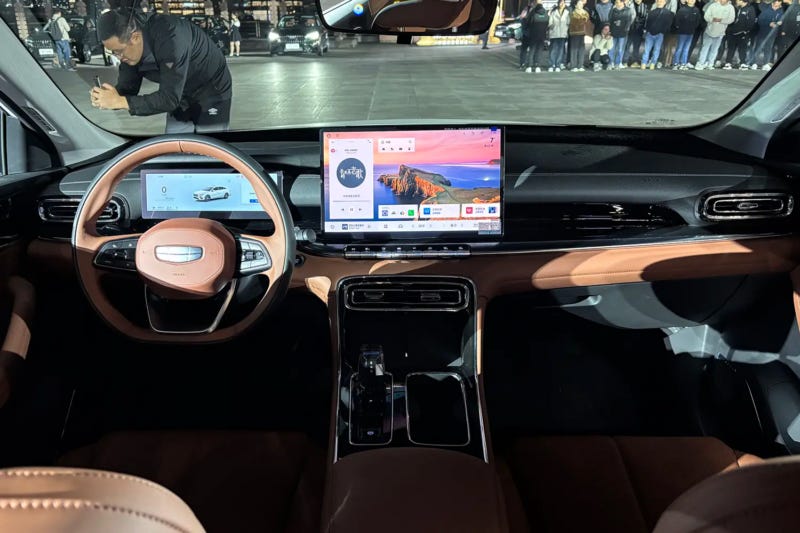
On 25 April, Le Monde simultaneously published an article on high-end electric cars to "convert senior executives to electric" (“convertir les cadres sup à l’électrique”), by Nicolas Valeano, and another, signed by Jordan Pouille from Beijing, on Geely's success thanks to petrol cars. The China correspondent describes the Emgrand saloon at $9,000, announced in November 2025: it is equipped with "the Flyme Auto intelligent cockpit, a driving assistance system, a nearly 15-inch screen and an in-house AI." You read correctly: $9,000, thermal engine, and yet native AI, connected cockpit. This is software BYD-ization infiltrating the most popular segment of the market, and which will soon be exported, whether the vehicle is electric or not. Geely is not choosing between internal combustion and electric; it is deploying the Chinese ecosystem on all fronts.
The Renault-Geely case: BYD-ization through alliance
The strategy is not limited to Volkswagen or Nissan. Renault has been conducting a similar experiment with Geely since 2024. The two groups created Horse Powertrain, a joint venture specialising in hybrid and thermal powertrains, which unveiled a new family of “all-in-one” powertrains in April 2026 capable of equipping both plug-in hybrids and petrol models. Above all, Renault sold 26.4% of its Brazilian subsidiary to Geely in November 2025, to jointly produce two new models on Geely’s GEA platform from the second half of 2026, and to export the technologies. A hybrid SUV derived from Geely, the Filante, was also launched in South Korea in March 2026. Result: in the first quarter of 2026, Renault’s sales jumped 7.3%, driven by “the distribution of vehicles for Geely in Brazil.”
As François Provost, the new CEO of Renault, summarised in April 2026: “We are with Geely in Korea and Brazil, we are helping Nissan to export from India. Outside Europe, we remain flexible on partnerships.”
BYD-ization also advances through alliances: Renault, like Volkswagen, no longer designs its engines or platforms alone; it borrows them from China to stay in the race.
AI, cloud and data: the other battle
Autonomous driving and intelligent assistants rely on AI models trained and executed in the cloud. Here, China has considerable assets. Alibaba Cloud, Tencent Cloud and Huawei Cloud offer processing infrastructures already exported to Singapore, Brazil, and the Middle East. Partnerships with Momenta or Horizon Robotics integrate AI models trained on Chinese traffic data, the densest in the world.
A manufacturer that chooses Horizon Robotics for autonomous driving is offered a turnkey solution, hosted on a Chinese cloud. It saves time and money, but progressively locks its architecture around Chinese standards. The exported car then becomes a data collector that continuously feeds AI models hosted in China, accentuating the technological lead. And when this car is a robotaxi, like Xpeng’s GX or Geely’s Eva Cab, the data loop becomes a massive competitive advantage: each kilometre travelled improves the AI of the entire fleet, reinforcing a budding technological monopoly.
Japanese and European manufacturers are now listening to their Chinese counterparts
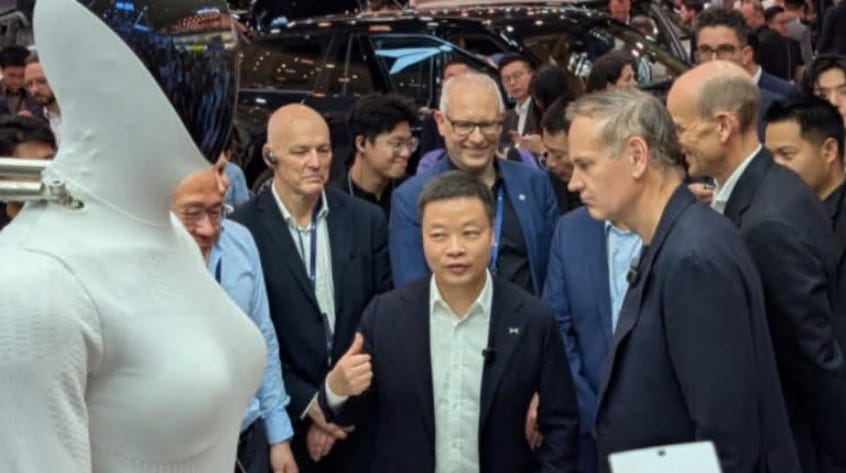
On 27 April, Nikkei Asia confirmed that Chinese manufacturers are now distancing their Japanese and European rivals thanks to AI and batteries. Volkswagen has just launched the ID. UNYX 08, an electric vehicle equipped with two Turing AI chips designed by Xpeng for “end-to-end” assisted driving. These chips, developed in-house by VW’s Chinese partner, replace traditional Western suppliers. The software ecosystem no longer merely feeds the central screen: it takes control of the vehicle’s perception and decision chain.
Nikkei Asia comments: “In 1985, Volkswagen was one of the first companies to establish a joint venture in China, as the Beijing government strove to develop its domestic automobile industry. Since then, the VW group has dominated the Chinese automobile market. Four decades later, the fact that a senior Volkswagen executive listens attentively to the announcement of a Chinese start-up specialising in electric vehicles testifies to the evolution of relations between Chinese automakers and foreign companies established in the country.”
Competing with the Apple/Google duopoly: the “diplo-economic” factor
The domination of iOS and Android rests on user trust, app stores and payment services, as well as the obligation to use these systems to access certain services (such as Digital Identity in France). China has built a parallel digital continent for its domestic market. Its international extension is underway.
In the countries of the Global South, privacy concerns are less centred on China than on the USA, and value for money is decisive. The US sanctions against Huawei forced the company to create a complete alternative, which other players can choose in order not to depend on the USA in their turn.
A BYD or Nissan car equipped with HarmonyOS, with a multilingual Chinese voice assistant and connection to the Huawei connected home, offered 30% cheaper than a Western equivalent, constitutes a value proposition difficult to ignore.
Provisional conclusion: the dual market is already here
We are not (yet) witnessing the replacement of iOS and Android. But a dual market is being established: on one side, the Google/Apple orbit; on the other, the Huawei/HarmonyOS orbit. The question is not whether the Chinese ecosystem can technically compete with the Americans (it can), but whether it can cross the geopolitical wall that is beginning to be erected.
Post-scriptum — The Chinese lock
An article published by Nikkei Asia on 28 April 2026, just before we published this article, sheds light, from another angle, on what is at stake here. While Western, Japanese and South Korean manufacturers are increasingly integrating Chinese building blocks into their vehicles – software, on-board AI, voice assistants, operating systems, driving data – Beijing is ensuring that these technologies cannot be simply absorbed by American, or more generally foreign, groups.
China’s blocking of Meta’s acquisition of Manus shows that China is careful that the opening of its technologies does not dispossess it of them. A technology developed by Chinese engineers, in China, with Chinese resources, can remain considered Chinese even if the company moves to Singapore or presents itself as offshore. In other words, China accepts that its ecosystem spreads, but it refuses that its strategic core be captured.
Foreign manufacturers adopt Chinese standards to remain competitive, while the Chinese state retains the ability to block the export or appropriation of technologies deemed sensitive. BYD-ization, beyond a market dynamic, is therefore indeed an architecture of power: controlled diffusion externally, strategic locking internally.
Meanwhile, awareness is progressing, including in the general press. On 28 April, Le Monde began a series entitled “How China is devouring Europe” (”Comment la Chine dévore l’Europe”), describing a Chinese power that “no longer competes only with traditional labour-intensive industries” but “is now imposing itself in innovation sectors and high value-added productions.” A sign that our concept is gaining traction beyond our columns: Estelle Brachlianoff, CEO of Veolia, tells the evening daily that she wants to “remain vigilant so as not to be ‘BYDized’.” The term we coined on 20 April is entering the vocabulary of CAC 40 executives.
NOTE: Our series of articles on BYD-ization
April 20, 2026. The BYD-ization
Vertical integration, scissor effect, strategic substitution...: the eight mechanisms by which some Chinese companies are redefining global industrial standards.April 27, 2026. The BYD-ization in action: when Volkswagen and Nissan become Chinese.
A Nikkei Asia report describes the application manual for the eight mechanisms of BYD-ization, by the very companies it threatens.April 28, 2026. The BYD-ization (continued) – Behind the automobile, the war of software ecosystems
The connected cabin is becoming the Trojan horse through which the Chinese ecosystem (HarmonyOS, AI, cloud) can compete with Apple and Google on their own turf.May 4, 2026. How Europe is Facing BYD-ization
After having devoured the world, old Europe is said to be “devoured” in turn.May 15, 2026. Luxury No Longer Roars. It Computes
The Maextro S800 looks like someone threw a Mercedes-Maybach, a Rolls-Royce, and a Porsche into a blender with a high-end smartphone.
May 16, 2026. Huawei No Longer Sells Only Luxury Cars. It Sells the Mine of the Future
And it’s the exact same core software running both!May 23, 2026. BYD-ization. Stellantis lets the wolf into the sheepfold… as a matter of survival
Survival for whom? For the shepherd, perhaps, but not for the sheep.
Our other articles related to BYD-ization:
April 18, 2026. DeepSeek V4 on Chinese Silicon (Huawei): A Signal for Asia, a Warning for Nvidia
Behind DeepSeek’s performance, an entire East Asian ecosystem is emerging, from Chinese inference to the sovereign ambitions of Japan, Korea, and ASEAN.May 5, 2026. China’s auto bloodbath rages on, by Han Feizi
As China’s EV makers savage each other in bloodlust competition, US, Japanese and German makers should just wave the white flag.May 21, 2026. The BYD-ization is advancing under the radar: European zombie factories, a passport to Chinese industry
Tactic for dodging tariffs and easing trade tensions could raise costs, compliance risks.
All our publications are free and Copyleft. They may be republished, in whole or in part, under following conditions:
→ keeping the title and content
(text, images, editor’s or translator’s notes, boxes)
→ crediting the author(s) and/or translator(s)
→ inserting a clickable link to the source.
Any monetization or commercial use of these publications is prohibited and will be subject to legal action.