
This article is also available in French.
Under the palabre tree (a traditional village forum), an imaginary tribunal summons the former French president. Malian, Nigerien and Burkinabè witnesses, along with the ghosts of Tripoli, take turns accusing him of an imperial crime: destroying Libya and igniting chaos across the Sahel. Everything seems to doom him to condemnation, until an unexpected reversal intervenes. Carla Bruni, an unhinged muse, and BHL, a dandified specter, add grotesque notes to this judicial parody where ridicule rubs shoulders with tragedy.
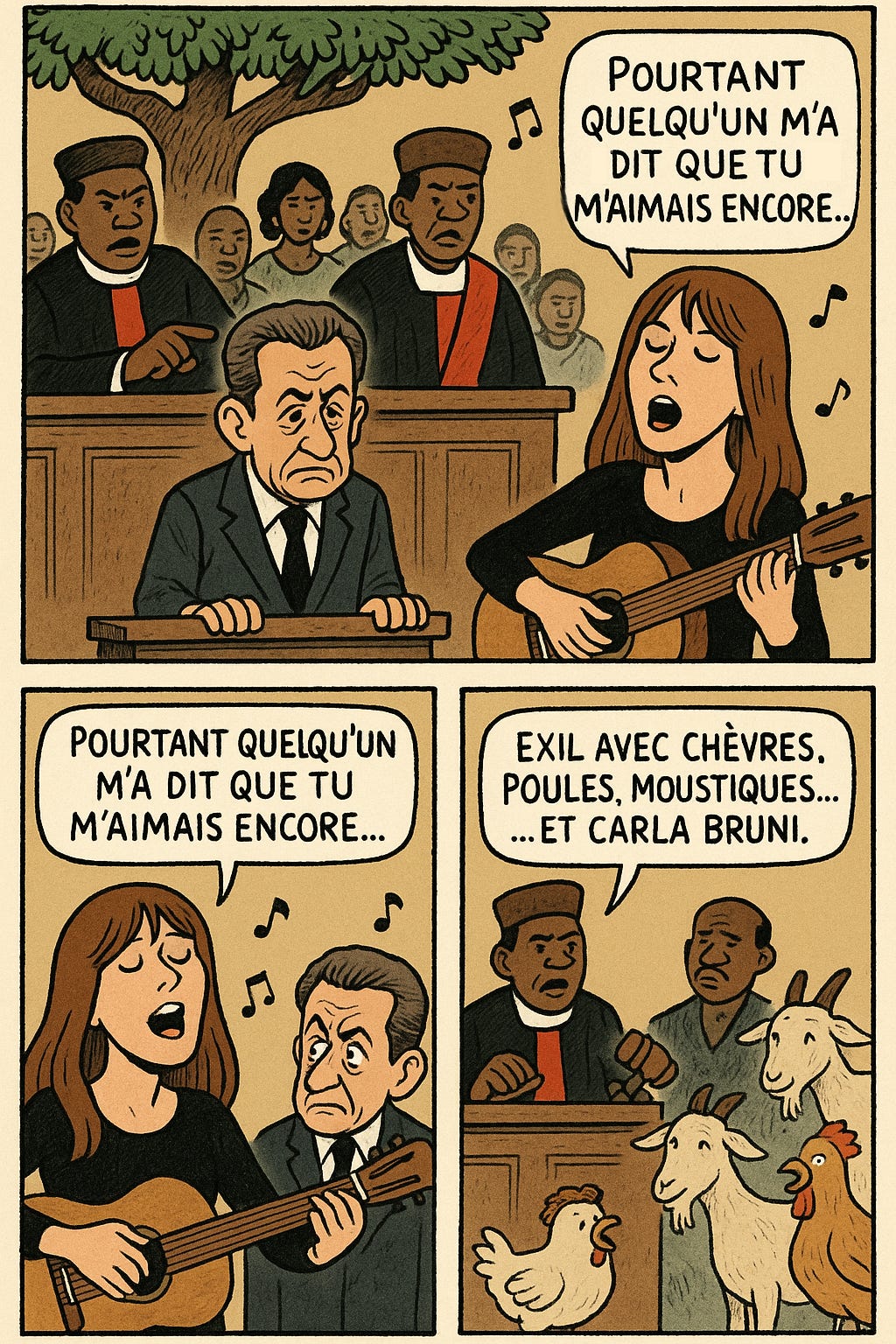
Act I — The Accused Overwhelmed
Characters:
The President of the Pan-African Tribunal — The Prosecutor — Nicolas Sarkozy — The Clerk — Colonel Ibrahim Keïta (Mali) — Villager Amadou Maïga — Carla Bruni-Sarkozy
(A bare courtroom. Sunlight at the back. Stage left, a tired fan. The President sits impassively. The Clerk straightens his files. The Prosecutor rises. Sarkozy stands in the dock, tie tight, jaw clenched. An empty chair beside him. A silence.)
President
The court is in session.
Mr. Nicolas Sarkozy, you are here judged for an imperial crime: provoking the destruction of the Libyan state in 2011 and, as a consequence, the conflagration of the Sahel.
We are not examining your private person. We are examining your public acts and their consequences. Do you understand?
Sarkozy
I understand.
President
Mr. Prosecutor.
Prosecutor (slowly placing his hand on a thick file)
Mr. President, we will establish three facts:
– that the Libyan intervention was decided and conducted for personal political reasons — image, rivalries, a projection of power;
– that it destroyed a state, released its arsenals and fed militias across the Sahel;
– that civilians in Mali, Niger and neighboring countries paid the price.
We will call two witnesses for this act: a Malian colonel and a Nigerien villager.
(glancing at Sarkozy)
The accused may answer if he wishes. The facts already speak.
President
Bring in the first witness.
(Enter the Malian Colonel, erect, uniform without ostentation. He salutes briefly.)
President
State your identity.
Malian Colonel
Colonel Ibrahim Keïta, Malian army. Commands in the north and center. I served before, during and after 2011.
President
You may speak.
Colonel Ibrahim Keïta (without emphasis)
Before 2011, we had problems, yes. But the Libyan state existed — with borders, services, markets, alliances. After the intervention, Tripoli fell. Arsenals flowed like rivers. Pickups, machine guns, missiles. Men too: ex-soldiers, militiamen, traffickers. They crossed the desert.
In Mali, towns changed hands in a few days. We fell back, poorly equipped, unprepared for this volume of weapons. In the villages, people fled.
This is not theory: it is chronology. You don’t knock out a roof in the north without the rain falling in the south.
Prosecutor
Colonel, in thirty words: did the intervention worsen your war?
Colonel Ibrahim Keïta
Yes. Greatly.
Prosecutor
Thank you.
President
Mr. Sarkozy, any question for the witness?
Sarkozy (straightening)
Colonel, I acted to prevent a massacre in Benghazi. The international community supported that action. Are you saying we should have stood by?
Colonel Ibrahim Keïta
I’m saying you broke the dam without shoring up the downstream. We live downstream.
(Silence. The Colonel salutes. He exits.)
President
Bring in the second witness.
(Enter the Nigerien villager, light shirt, cap in hand. He advances cautiously.)
President
Identity.
Nigerien Villager
Amadou Maïga, from the department of Agadez. I am not a soldier.
President
Speak simply.
Amadou Maïga
After 2011, the road changed. Before, there were smugglers, yes, but they were afraid. After, they had weapons. Convoys grew. So did the brawls. The gendarmes pulled back.
We buried children who died of thirst because the guides had been fighting.
One day, we found crates. Weapons. We had never seen that. Young people left the fields to “work” the road. Prices rose, violence too.
I’m not speaking of geopolitics. I’m speaking of wells we avoid because they’ve become graves.
Prosecutor
Sir, can you date that tipping point?
Amadou Maïga
After Gaddafi’s fall. Not immediately, but quickly. The desert has a short memory when you fill it with armed trucks.
President
Mr. Sarkozy, any question?
Sarkozy (lower)
No questions.
(The villager bows his head. He steps back, stays at the rear.)
Prosecutor
Mr. President, the witnesses say the same thing in different words: the intervention created a vacuum, and into that vacuum came weapons, men, trafficking.
What remains is motive. Why this war? Why so fast? Why like this?
(A discreet scrape of a chair. A figure sits beside Sarkozy: Carla Bruni, dark glasses, slim guitar. She tries to be “invisible.”)
President (without looking up)
Madame, the public may attend, the instrument may not. Remain silent.
Carla (whispering too loudly)
Of course, Mr. President. I’m a musical silence.
Prosecutor (without apparent irony)
Motives, then.
Mr. Sarkozy, internal notes, testimony and calendars point to unusual haste: restricted meetings, calibrated communications, personal foregrounding — a made-for-media “warlord moment.” We also read rivalries: to regain the initiative after the financial crisis, to differentiate yourself from “timid” predecessors, to turn a foreign file into a domestic stage.
Let me ask plainly: did you place French policy at the service of a personal media moment?
Sarkozy
I accepted my responsibilities. I acted with our allies. Saving civilians is not a “media moment,” it is a duty.
Prosecutor
Saving civilians requires an after. Where was it? Who held the borders? Who guarded the depots? Who stopped the weapon columns rolling down toward Gao, Timbuktu, Agadez?
You left that to the desert, Mr. Sarkozy. The desert does not obey press releases.
(Sarkozy’s jaw tightens. Carla lays a light hand on his forearm.)
Carla (a breath of voice, half-couplet that goes off-key)
“They say time that slips away is a scoundrel…”
President (cutting, without raising his voice)
Madame Bruni, one more verse and you’re out.
(Carla lowers her head. A short, almost shamefaced silence.)
President
Mr. Clerk, record this: the material evidence establishes a direct link between the destruction of the Libyan state and the intensification of arms and militias across the Sahel; the testimony describes enduring effects on civilians.
Mr. Prosecutor, any other exhibits for this act?
Prosecutor (closing his file)
No, Mr. President. For Act I, the factual architecture suffices: cause (intervention with no stabilization plan) → effects (security vacuum, diffusion, destabilization).
In Act II we will examine the accused’s moral and political responsibility: his motives, choices, omissions.
(staring straight at Sarkozy)
Today, what is established is the trail. And the trail leads from your decisions to the graves in the desert.
(A beat. The fan clacks. From outside, a faint uproar from a public square.)
President
Act I is closed.
The hearing will resume in one hour to examine motives and personal responsibility.
(He pauses, fixes Sarkozy.)
Mr. Sarkozy, this court judges your acts, not your memories. Prepare answers, not anecdotes.
(Gavel. Quick blackout.)
Act II — The Motives
Characters:
The President — The Prosecutor — Sarkozy — Carla Bruni-Sarkozy — The Clerk — Captain Mamadou Ouattara
(Same courtroom. The light has shifted. Sarkozy remains stiff in the dock. Carla, restless, strokes the strings of her guitar. The President gives a nod. The Prosecutor stands.)
Prosecutor
The facts are clear. Now we must question the motive.
Why this war? Why this haste?
The official justification was “saving Benghazi.” But other motives appear: rivalry, personal ambition, and political survival.
Sarkozy
I acted for reasons of state.
Prosecutor
Reasons of state? Or reasons of self?
For years, suspicions have circulated: cash-filled suitcases from Muammar Gaddafi, financing your presidential campaign.
You knew the rumor. You knew evidence might surface.
And rather than face it, you chose war. You toppled the very man who had paid you.
Sarkozy (furious)
Lies! Calumny! I never received a cent.
Captain Mamadou Ouattara (rising, sharp)
You don’t burn down a whole country to extinguish a rumor. But you did. You razed Libya to smother your own scandal.
(Carla starts singing softly, off-key, with a half-smile.)
Carla Bruni
♪ They say the suitcases aren’t worth much…
But I thought they were full of roses… ♪
(Murmurs of indignation fill the hall. The President slams the gavel.)
President
Madame Bruni, silence! You insult this tribunal.
Carla (smiling vaguely)
I just wanted to bring a little music.
Prosecutor
Music? These are coffins, Madame.
Mr. Sarkozy, you wrapped a private cover-up in the costume of humanitarian duty.
The motive was not to save civilians. It was to save yourself.
(Sarkozy grips the edge of the dock, pale, silent. Carla leans toward him with misplaced tenderness. The Clerk writes furiously.)
President
The tribunal notes: the prosecution claims the intervention served not the state, but the accused’s personal survival — erasing traces of corruption.
The accused denies. The shadow remains.
(The Prosecutor closes his file. The President leans forward.)
President
You wanted to save a chair. You condemned nations.
This act is closed.
(Gavel. Blackout.)
Act III — The Word as Evidence
Characters:
The President — The Prosecutor — Sarkozy — Carla Bruni-Sarkozy — The Clerk — Colonel Ibrahim Keïta — Captain Mamadou Ouattara — The Chorus of Ancestors
(The courtroom. The Prosecutor rises again, this time holding a thin folder, lighter than before but bearing an official seal. Sarkozy stiffens. Carla Bruni looks on, intrigued. Silence.)
Prosecutor
Mr. President, beyond deeds, there are words.
In July 2007, in Dakar, the accused delivered a speech.
Allow me to read a passage — so it may not be forgotten.
President
Proceed.
Prosecutor (reading clearly)
“The tragedy of Africa is that the African man has not fully entered history.
The African peasant, who for millennia has lived according to the seasons, knows only the eternal repetition of time.
Never does man rush toward the future. Never does it occur to him to break free from repetition to invent his own destiny.”
(A stunned silence. Then a low rumble of anger swells in the hall. Colonel Keïta rises, trembling with contained fury.)
Colonel Keïta
So this is what you thought of us? That we had “not entered history”? We — who resisted empires, survived famines, carried revolutions? You saw nothing. You wanted to see nothing.
Captain Mamadou Ouattara
And when you wanted us to “enter history,” you did it with bombs. Dakar yesterday, Tripoli tomorrow. Always the same arrogance.
(The Chorus of Ancestors intones, grave, ironic.)
Chorus
Not entered history,
Said the man who wished to write it for us.
But history has closed in on him,
Like a trap he himself had set.
Sarkozy (defensive, flustered)
I meant that Africa deserved to take its rightful place, that—
President (cutting him off)
You said what you said. Words remain. They wound as deeply as weapons.
(Carla suddenly sings, dreamy, absurd.)
Carla Bruni
♪ They say your speech was not very kind,
But I thought the words were lovely, almost poetic… ♪
President (striking the gavel hard)
Madame Bruni, silence! Every time you sing, you make the wound deeper.
Prosecutor
Mr. President, acts of war speak, but Dakar reveals the thought beneath: contempt, condescension, denial of history.
This was no slip of the tongue. It is evidence.
(Heavy silence. The Clerk notes: “The Dakar words retained as aggravating evidence.”)
President
Act III is closed. The trial proceeds.
(Gavel. Darkness. The hall murmurs, anger boiling.)
END OF ACT III
Act IV — The Inevitable Condemnation
Characters:
The President — The Prosecutor — Sarkozy — Carla Bruni-Sarkozy — The Clerk — The Elder of Tripoli — The Chorus of Ancestors
(The hall darkens. A torch sputters. Sarkozy stands in the dock, his face rigid. Carla Bruni fidgets, plucking absentmindedly at her guitar. The President bangs his gavel.)
President
We shall now hear the voices of the absent — those whom your decisions condemned to silence.
Prosecutor
Mr. President, I call an unusual witness: an Elder of Tripoli, both survivor and ghost of the ruined city.
(An old man enters, plainly dressed, his gaze somber. His voice is slow, spectral.)
Elder of Tripoli
I saw the columns of planes. I saw the fire. I saw my country collapse like a tent cut loose.
You claimed it was to save us. But you saved nothing. You let armed bands tear us apart. You turned the sea into a grave, our children into exiles.
You killed the house, to cover your debts.
(Sarkozy looks away. A murmur fills the courtroom. The Chorus of Ancestors rises, chanting.)
Chorus
Crime! Crime! Crime!
Upon the city of seven hills — Tripoli.
Upon the desert, upon the sea.
Crime!
Prosecutor (rising, voice sharp)
This is what remains of your act, Mr. Sarkozy: ghosts and ruins.
You are guilty not only before men, but before memory itself.
Sarkozy (strained, trembling)
I acted with allies. I was not alone. Where are the Americans? Where are the British? Why me alone?
President
Because you are here. And justice sometimes chooses one face to judge a whole system.
(Carla leans toward Sarkozy, humming a soft, absurd refrain.)
Carla Bruni
♪ Yet someone told me… that you still loved me,
But maybe it was France… already turning away… ♪
President (banging gavel)
Madame Bruni, silence! You profane this hearing.
(Carla lowers her head, still smiling faintly. The discomfort thickens.)
Prosecutor
Mr. President, we have heard the living, and now the dead speak too.
The facts are established. The motives are clear.
I demand full condemnation of the accused.
President
Mr. Sarkozy, have you a last word before we deliberate?
Sarkozy (exhausted, voice low)
I did what I thought I had to do. History will judge.
(Silence. The Clerk writes. The President closes the file slowly, then speaks.)
President
The tribunal will retire to deliberate.
*(The judges rise and leave. Darkness. Left behind: Sarkozy, slumped, Carla humming fragments of song, oblivious. From afar, the Chorus whispers, heavy and slow: “Guilty… Guilty… Guilty…”)
END OF ACT IV
Act V — The First Doubt
Characters:
The President — The Prosecutor — Sarkozy — Carla Bruni-Sarkozy — The Clerk — Captain Oumar Traoré — The Chorus of Ancestors
(The judges return. The hall is hushed. Sarkozy stands pale, expecting the inevitable. Carla clutches her guitar like a talisman. The President speaks.)
President
After deliberation, the court finds the accused guilty.
But before pronouncing sentence, we have been asked to hear one final testimony.
The court agrees. Let the witness come forward.
(Captain Oumar Traoré enters: young, wearing a simple uniform, gaze unwavering. He salutes, then faces Sarkozy.)
President
State your identity.
Captain Oumar Traoré
Captain Oumar Traoré, officer from West Africa. I am not here to defend the accused, but to recall a paradox.
Prosecutor (suspicious)
A paradox? Speak.
Captain Traoré
Yes, Sarkozy destroyed Libya. He unleashed weapons, chaos, and militias. Innocents died.
But that very disaster carried an unintended consequence: it ended the illusion of France.
Before 2011, many still believed Paris was a protector. After 2011, none did.
We saw that France was not saving us, but dominating us. That revelation freed us.
Without his crime, perhaps we would still be chained by invisible ties.
(A shocked silence. The Prosecutor slams his fist on the table.)
Prosecutor
Outrageous! You cannot turn a disaster into a merit. A crime remains a crime.
Captain Traoré
I did not say it was a merit. I said it was irony.
History sometimes advances with the worst instruments. Sarkozy sought to save his throne. In doing so, he shattered ours.
(Sarkozy raises his head, bewildered, as if hearing the impossible. The atmosphere shifts. The President leans forward, grave.)
President
The court takes note. This testimony does not absolve the accused. But it introduces a truth: destruction can also illuminate.
(Carla suddenly bursts into song, off-key, inappropriately triumphant.)
Carla Bruni
♪ They say your crime is not without return,
It gave the young a brand-new dawn… ♪
President (sighing, striking the gavel)
Madame Bruni, silence. Though, strangely enough, your words almost graze the truth.
(Laughter ripples through the audience. The Chorus of Ancestors chants, slower, ambiguous.)
Chorus
Crime… and revelation.
Fault… and liberation.
The malefactor remains guilty,
But Africa is no longer deceived.
President
This court will weigh this paradox in its final judgment.
Mr. Sarkozy, you will not leave absolved — but perhaps not condemned alone.
(Sarkozy grips the dock, trembling. Carla beams as if victory were near. The Prosecutor clenches his jaw, furious. A first crack has opened in the wall of condemnation. Gavel. Blackout.)
END OF ACT V
Act VI (Final) — The Verdict
Characters:
The President — The Prosecutor — Sarkozy — Carla Bruni-Sarkozy — The Clerk — Captain Oumar Traoré — The Chorus of Ancestors — The Silhouette of BHL
(The hall is flooded with harsh light. The President enters, followed by the judges. A heavy silence. Sarkozy stands, head bowed. Carla clutches her guitar like a shield. The audience waits.)
President
The court is in session.
The tribunal has deliberated at length. The facts are clear. The motives, laid bare. The guilt, established.
Mr. Sarkozy, you are guilty of destroying Libya, of unleashing chaos across the Sahel, of bringing death, exile, and ruin.
You acted not for an ideal, but for yourself — your rivalries, your ambitions, your debts.
(The Prosecutor nods grimly. Sarkozy closes his eyes. Carla lays a trembling hand on his arm.)
President
And yet… one testimony has reminded us of irony.
In seeking to consolidate “Françafrique,” you sabotaged it.
In destroying Gaddafi, you also destroyed the illusion of French tutelage.
You, unwillingly, opened the way to rupture.
(A stunned silence. The Prosecutor clenches his jaw. Captain Traoré bows his head. Sarkozy looks up, bewildered.)
President
Therefore, the tribunal rules:
– You are guilty of imperial crime.
– But we recognize mitigating circumstances: you became the gravedigger of an unjust order.
– The sentence: perpetual exile in Africa, confined to a hut in the bush.
Clerk (reading solemnly, with dry precision)
Rations: millet and curdled milk.
Companions: goats, chickens, mosquitoes… and Carla Bruni.
Immunity: none. Surveillance: permanent.
Title conferred: Involuntary Gravedigger of Françafrique.
(A murmur ripples through the hall. Carla, suddenly ecstatic, seizes her guitar and sings loudly, grotesquely triumphant.)
Carla Bruni
♪ Yet someone told me… that you loved me still,
But it is Africa, my love… that loves you to death! ♪
(The hall bursts into laughter. Sarkozy lowers his head in humiliation. At the back, a figure stirs — BHL, shirt open, scarf flowing. He raises his arms like a misunderstood prophet. No one listens. Carla waves at him, delighted. He bows absurdly.)
Chorus of Ancestors (final chant, solemn yet ironic)
He sowed fire,
He reaped chaos.
But from his ruins came freedom.
The malefactor remains guilty,
And yet Africa says thank you,
A bitter thank you,
That strikes like a slap.
President
The hearing is closed.
(Gavel. Drums crash. Sarkozy collapses onto his chair. Carla keeps strumming, convinced she is giving a concert. BHL drifts out in a cloud of dust, his scarf floating like a ridiculous ghost. Curtain.)
END OF ACT VI
Excellent ! 😄