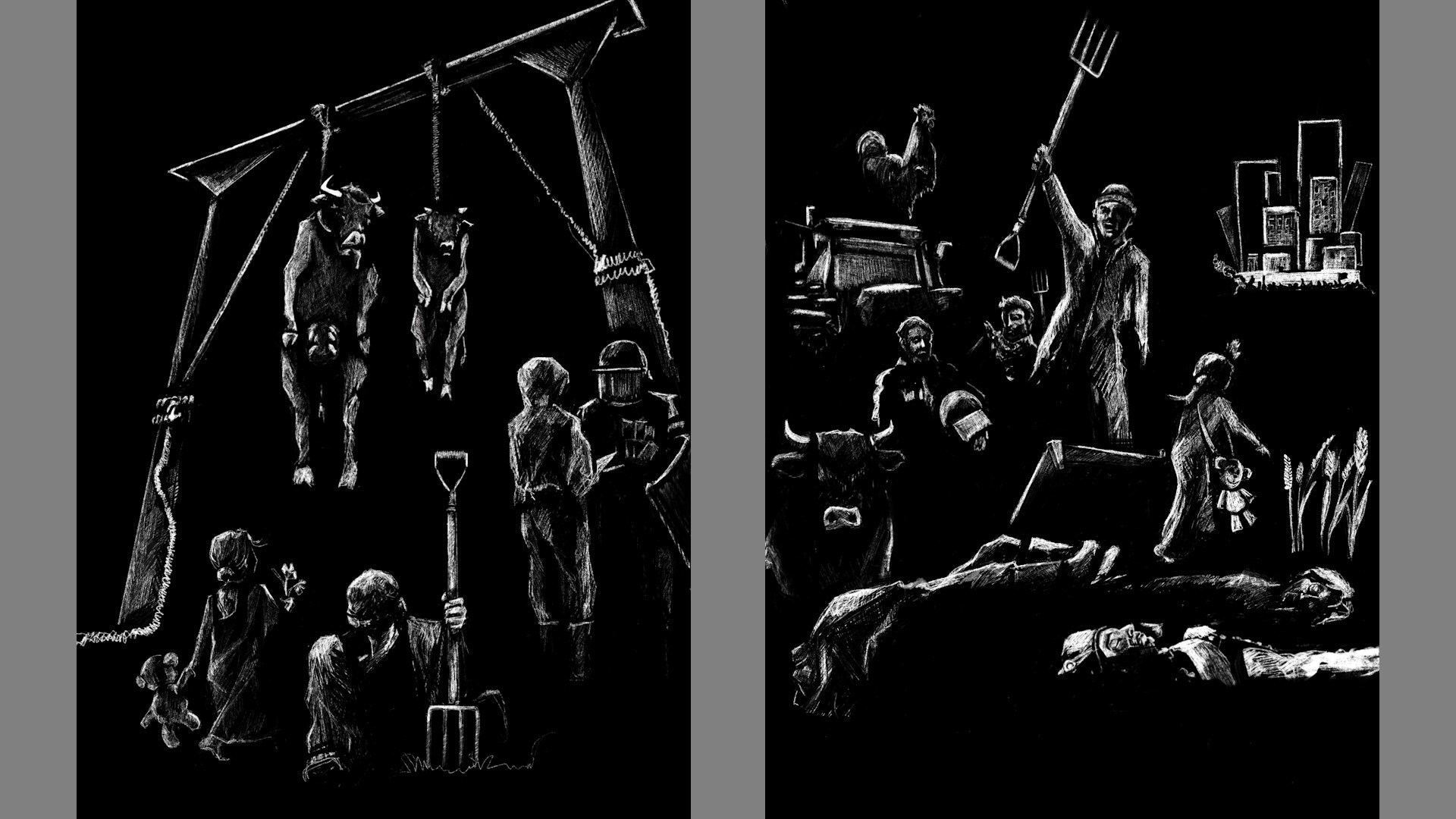
Slaughter Without Debate
Contagious Nodular Dermatosis, Farmer Accounts and the Neutralization of Agricultural Conflict


Original français - Versión española - Versione italiana - Versão em português
I. The Raw Fact: “A Carnage,” as Seen from the Ground
Since summer, the French bovine sector has been affected by Contagious Nodular Dermatosis (CND). Health authorities describe it as a viral disease transmitted by biting insects, causing fevers and nodules, and justifying, according to the ministry, “drastic sanitary measures.” More than 3,000 animals are said to have been slaughtered, representing about 0.02% of the French herd.
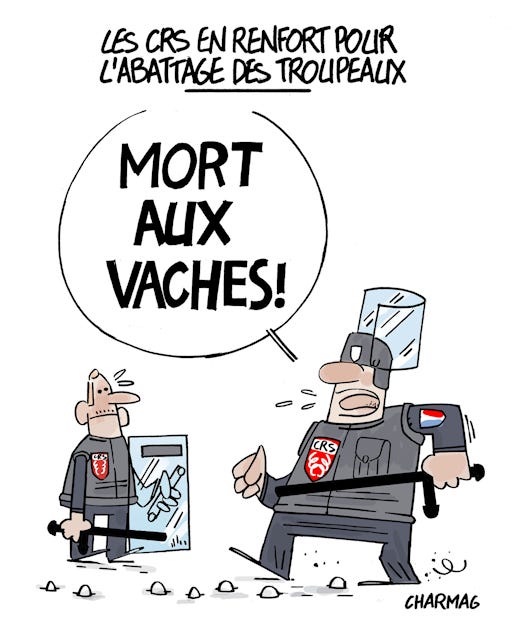
These figures, repeated in official statements, say nothing about what the concerned breeders are experiencing. The testimony of Pierre-Guillaume Mercadal about the battle fought in Ariège against the attempted slaughter of a herd of 200 cows, of which only one had been declared positive, describes a completely different reality…
[see video and transcript of P.-G. Mercadal’s testimony here].
The breeder begins by setting the scene, unambiguously:
“We were mobilized in Ariège to fight against the absolutely aberrant slaughter of cows. Literally a carnage, it was total chaos.”
He insists on a point rarely mentioned in public debate:
“We are killing cows whose meat and milk are not problematic for consumption. There can be no human contamination and the mortality rate for these animals is extremely low.”
The improvised mobilization lasted three days. Breeders “from all unions, non-unionized people,” joined by citizens, gathered on site, with no resources, in precarious conditions:
“For 3 days, we had no chairs, no shelter, no toilets. The second night, it rained, we slept in our cars.”
This account does not dispute the existence of the disease. It describes something else: the experience of an administrative decision applied without nuance, lived as a brutal destruction of the tools of their trade and of agricultural long-term time. This is what the breeder summarizes as follows:
“The State put monumental pressure on a family. They killed their cows, they took away their tools of work, they killed the work of their ancestors that they intended to pass on.”
This point is central. Behind the word “slaughter,” there are not only animals, but farms, lineages, a broken continuity.
II. The Official Response: A Health Crisis, Nothing More
Faced with this mobilization, the institutional response is presented as clear, coherent, and strictly technical. The Minister of Agriculture, Annie Genevard, “defended her strategy” during a visit to Toulouse, recalling that the virus is “extremely contagious” and justifies exceptional measures.
But in fact the minister’s “strategy” is nothing more than the strict application of European Regulation 2020/687. Entering into force in April 2021, this text governs responses to highly contagious animal diseases. It imposes the immediate slaughter of infected or contact animals for any disease classified in “Category A,” which is the case for CND. This regulation aims to harmonize sanitary responses at the Union level, avoid the pitfalls of a multi-speed system, and reassure markets. But its rigid application leaves little room for maneuver to states, territories, and breeders.
This “strategy” has already been implemented “in the same way in recent months in Italy and Spain,” as the European Commission explains on its website.
The argument from authority is reinforced by the alignment of competent bodies: this policy is presented as “the strategy recommended by the National Council of the Order of Veterinarians” as well as by “independent scientists, notably those from the National Agency for Food, Environmental and Occupational Health Safety.” On the mortality question, the scientific director of animal health at ANSES, Éric Cardinale, is often cited, mentioning estimates ranging “from 5% mortality according to the World Organisation for Animal Health to 10% for the United Nations Food and Agriculture Organization.”
Within this framework, the farmers’ disagreement is never treated as a conflict of rationalities, but as an understandable emotional reaction, soon surrounded by “rumors” and “extremely relayed false information.” The debate then shifts: it no longer concerns the proportionality of the measure, nor its economic and social consequences, but the validity of the discourses challenging it. Thus, from the moment the crisis is entirely confined within the sanitary field, any questioning of its structural effects (disappearance of farms, lasting weakening of local production, future dependence) becomes external to the subject. Politics dissolves into procedure.
III. When Fact-Checking Replaces Investigation
The core of the neutralization mechanism appeared notably in how franceinfo treated the question in its program “Le vrai ou faux” on December 16, 2025.
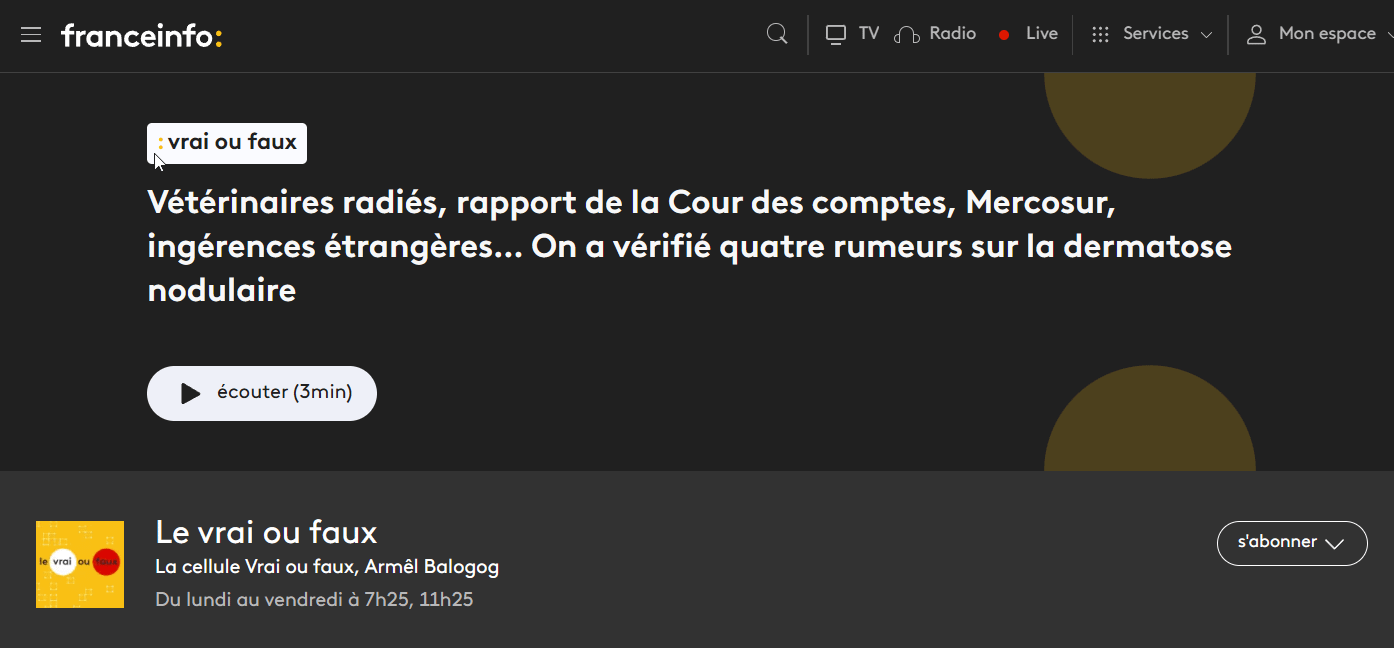
The economic aspect, that of a possible link between the slaughters and imports of South American meat.
The question is formulated as follows:
“Is this disease a pretext to favor the importation of cattle from Mercosur?”
The answer is a few lines long:
“Several rumors also accuse Europe of using nodular dermatosis as a pretext to impose cattle from Mercosur on the French market, within the framework of negotiations for the agreement between the European Union and several South American countries. However, according to a European source contacted by franceinfo, this is entirely false. There is no economic or political strategy at the European level linking these slaughters to Mercosur.”
No document is cited. No commercial timeline is mentioned. No industrial actor is interviewed. The refutation relies exclusively on the statement of “a European source contacted by franceinfo,” presented as sufficient to close the subject.
The implicit reasoning is as follows: since there is no “economic or political strategy” explicitly formulated at the European level, then any link between the slaughters and imports would necessarily belong to the realm of rumor. Yet this way of proceeding immediately evacuates the question of effects, retaining only that of declared intentions. It assumes that an economic phenomenon exists only if it is recognized as such by the institution that benefits from or pilots it. This is an extremely restrictive definition of causality.
This point is central: a weakening of local supply, whatever its initial cause, mechanically creates a vacuum for imports. This does not suppose either explicit coordination or a political admission. The absence of a formalized “strategy” says nothing about the real consequences of a sanitary policy applied without structural compensation. On this ground, franceinfo does not conduct an investigation; it settles for an institutional denial. Fact-checking thus becomes a tool of closure, not an instrument of enlightenment.
Disinformation as a Presupposition, Not a Question
The question is not posed openly, but formulated in a biased way:
“Does the disinformation mainly come from France or from abroad?”
The qualification of “disinformation” is thus accepted from the outset. It is no longer a matter of establishing whether certain criticisms are founded or not, but of identifying their origin. The debate changes nature: it becomes a problem of origin and networks, not of content. From there, the text strings together several registers. It first mentions “attempts at foreign interference,” attributed to “pro-Iranian and British ultra-conservative and anti-European networks,” then mentions an X account “based in the United Kingdom” that disseminated a video “generated by artificial intelligence.”
The discourse then shifts towards French actors, described as “far-right, conspiracy theorists or Covid-skeptics.” Several names are cited, including that of Philippe de Villiers, presented as having established a “fallacious” link between the slaughters and the agreement with Mercosur. franceinfo specifies:
“In doing so, Philippe de Villiers takes up the concept of the great replacement – an unfounded concept usually used to denounce immigration and a supposed conspiracy to replace French civilization – to denounce the importation of foreign cattle.”
Through this association, the economic criticism of the slaughters is indirectly linked to a conspiratorial rhetoric already disqualified in other contexts. The mechanism is clear: by linking the agricultural theme to figures and concepts deemed illegitimate, the subject itself becomes suspect. The result is a discursive lock. Any questioning of the structural consequences of the sanitary policy can now be placed in the field of disinformation, either foreign or domestic, but in any case external to rational debate.
Within this framework, the farmers’ voice disappears as an autonomous political voice.
The farmers’ voice is either ignored, considered emotional, or implicitly vulnerable to manipulation. The conflict is not settled; it is displaced outside the field of the sayable.
This absence of response, and more broadly of public debate, is not the result of a governmental change or a temporary disorganization. Since the emergence of the first cases in the summer of 2025, the Minister of Agriculture has remained the same: Annie Genevard, in office without interruption since September 2024. She has followed the dossier from start to finish, from the first alerts to the slaughter strategy and its media justifications. This means that the choices made were made knowingly, in a context of political and administrative stability, with the necessary time to consult, adjust, or dialogue.
IV. The Argentine Mirror: A Scenario Already Observed
What makes the French debate so difficult to conduct is that it is immediately locked into an artificial alternative: either a pure health crisis, or a conspiracy theory. Yet there is a third, more uncomfortable but better-supported by experience: that of non-intentional systemic effects.
Argentina provides an enlightening precedent in this regard. There, the bovine sector was not destroyed by a single decision nor by an explicit political announcement. It was gradually dismantled by the superposition of economic constraints, export incentives, and policies presented as rational in the short term.
The result is that in a country among the world’s major meat producers, local consumption has collapsed, under the effect of price increases and the priority given to external markets. This evolution was never formulated as a project to reduce food sovereignty. It imposed itself as a fait accompli. This point is essential to understand what is at stake today in France. It is not necessary for a formally assumed “economic and political strategy” to exist for a policy to produce effects converging with external commercial interests. It is enough that the destruction of a local productive capacity is neither compensated nor considered in the long term.
In the French case, the difference is one of method, not logic. Where Argentina saw its sector contract under market pressure, France begins by reducing its production capacity in the name of sanitary security. In both cases, the risk is identical: transforming a national food resource into an adjustment variable of a globalized system.
V. Returning to the Field: A Voice Made Inaudible by Framing
At no point does the breeder’s account present itself as a general theory. It starts from what was seen, lived, endured. It is precisely these concrete elements that the media framing tends to dissolve into abstract categories: health crisis, rumors, disinformation.
Yet what Mercadal describes is based on simple reasoning, anchored in practice. He questions the very coherence of the applied strategy:
“A virus, you don’t stop it by exterminating the population that can be affected. Or else you have to kill the agent and the vector. And here, the vector, they are ticks, flies, and mosquitoes.”
This remark is not formulated as an alternative expertise, but as an empirical evidence, shared, he says, by “all the scientists I have spoken to about it.” It points to a gap between administrative logic and biological reality.
The account also insists on the human dimension of the decision, totally absent from fact-checkings:
“With this harassment and pressure from the State, one of the two breeders cracked. So it tore a family apart. You have to imagine the human side, it’s crazy.”
It is this dimension that media treatment transforms into emotional noise, before neutralizing it by linking it to networks, interferences, or controversial political figures. The peasant voice then ceases to be a situated voice; it becomes suspect material.
Yet, what this breeder recounts is nothing exceptional. He describes what it means, concretely, the mechanical application of a sanitary rule to a profession based on long time, transmission, and continuity. He describes what a decision produces when it foresees neither repair, nor reconstruction, nor real dialogue.
It is in this sense that his voice matters. Not because it would be infallible, but because it reveals what communication devices do not show: the irreversible effects of a policy presented as temporary, and the way a sector begins to unravel without it ever being named as such.
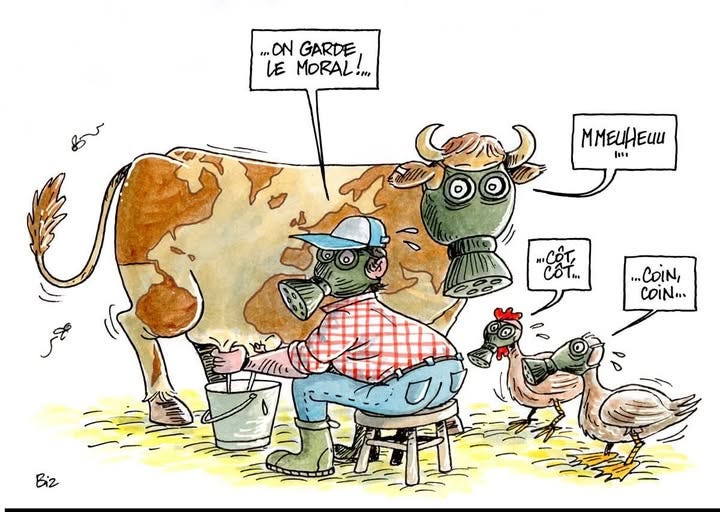
VI. And Elsewhere? The Japanese Case, Parliamentary Voice
When confronted with the same disease in late 2024, Japanese society reacted differently. No herd was entirely destroyed. Sick animals were euthanized, others isolated. Massive vaccination was deployed within a 20 km radius around the outbreaks. The epizootic was contained within a few weeks. Japan then modified its regulatory framework to allow, in case of a new flare-up, orderly slaughter. But it started with a proportionate strategy, based on cooperation and vaccination, with transparent public compensation and regional management.
This approach strongly contrasts with the French decision to impose total slaughter from the first case, without possible local discussion. In Japanese sources, the French strategy is perceived as extremely brutal, hardly understandable from a zootechnical standpoint, and above all socially destabilizing.
This is not just a question of cultural distance. It is a difference in arbitration: between institutional reactivity and proportionality. Between administrative mechanics and margin of choice. Between strict application and the capacity to interpret the rule.
At the same time, in France, several parliamentarians proposed other paths. In a letter addressed to the Minister of Agriculture in July 2025, they called to “get out of the systematically deleterious total slaughter.” They proposed seven concrete measures: ring vaccination (around detected outbreaks), targeted slaughter (of only sick animals), temporary modification of the European status of CND (which currently imposes total slaughter), compensations (rapid and adapted to the real loss), and vaccine sovereignty (capacity for France to produce and administer vaccines itself). Citing the European Food Safety Authority (EFSA) and the World Organisation for Animal Health (WOAH), they recalled that vaccination could prevent viral circulation and avoid the destruction of herds. Above all, they pointed to the irreversible loss represented by these slaughters: for genetic heritage, agricultural transmission, the breeder-animal bond.
The minister did not respond publicly. The slaughters continued. The minister in question, Annie Genevard, has been in office since September 2024. She has gone through several government reshuffles and has been reappointed each time, which means she has had time to deepen the dossier, follow its evolution since the first outbreaks in Europe, and engage in dialogue with field actors, notably breeders and parliamentarians.
VII. A Crisis of No Return
From an accounting standpoint, the affair seems minor: less than 0.02% of the national herd concerned. But the consequences are profound. A new divide has just occurred between an administrative world and an agricultural world, between a single sanitary strategy and multiple local realities. The sacrifice of the breeder-herd bond, increased distrust towards authorities, the erasure of any collective debate on means of action: here is the balance sheet.
The current strategy relies on a sanitary logic of reactivity: slaughter quickly to avoid propagation. It is effective in the short term, harmonized at the European scale, protective of the European market. But it poses a problem of method. Rigid, applied without nuance or debate, it clashes with social and human realities. Especially since the derogations provided for by European law (emergency vaccination, partial slaughter) exist on paper but are not activated. France’s choice is not solely dictated by Brussels: it is a maximalist reading of a regulation that surpasses it, a silent and purely administrative reading. Hence the rupture. Hence the anger. And hence the question: in a crisis that touches on living beings, work relationships, and agricultural history, can one still decide without listening?
France is not alone in this case. Italy, for example, slaughtered over 6,000 bovines between 2022 and 2023, with similar testimonies of local tensions and destruction of farms. In Spain, veterinarians and breeders have repeatedly requested an adaptation of regulations to avoid “irremediable” losses. The application of European Regulation 2020/687 has also been described as “inflexible” by some agricultural union organizations. The debates have nevertheless remained marginal, often treated locally, without national resonance. There too, law preceded dialogue.
France has slaughtered without debate, breaking the trust of the agricultural base towards its national institutions.