

How should we read the media when reality itself is contested? A comparative analysis of two articles published simultaneously on the same subject, respectively by Le Monde and Simplicius.
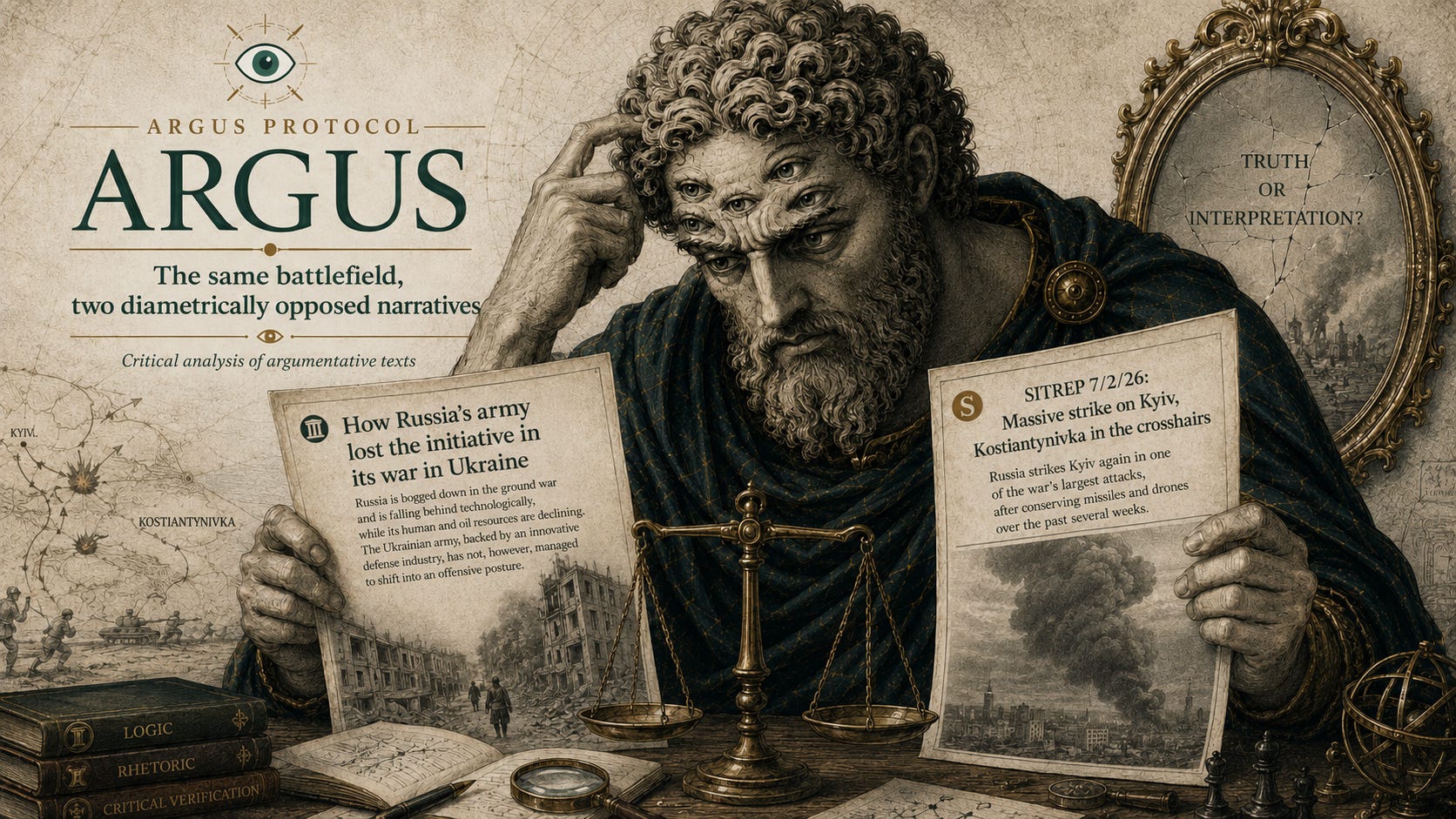
Sometimes the calendar gives us a real-life laboratory. On the morning of July 3, 2026, two texts were published an hour apart, both taking stock of the war in Ukraine. The first, at 5 a.m., in Le Monde, a major French newspaper of record, written by two journalists. The second, at 6:20 a.m., on Substack, by an independent analyst known as Simplicius.
The first is titled: Guerre en Ukraine : comment l’armée russe a perdu l’initiative (War in Ukraine: how the Russian army lost the initiative).
The second: Sitrep 7/2/26: Another Massive Strike on Kiev, as Konstantinovka on the Brink.
Same date, virtually the same moment. Same subject: the military situation in Ukraine. And yet, everything sets them apart. One claims that Russia is bogged down and losing strategic ground. The other argues that Ukraine is on the verge of collapse and that Russia has taken back the driver’s seat.
These two narratives cannot both be true, at least not in their entirety. They do not describe the same world. Yet both rely on facts, sources, maps, and experts.
How can we make sense of it? How can we read these texts without being swept away by the most seductive rhetoric?
To see more clearly, I subjected both articles to the ARGUS protocol—a rigorous analytical framework that examines argumentative structure, source quality, symmetry of treatment, omissions, and the degree of propaganda. The findings are eye-opening.
1. The Two Narratives in Presence
Le Monde : Russia is losing the initiative
Le Monde‘s article starts with a Russian airstrike on Kiev, presented as an “admission of frustration”—a psychologising term that immediately sets the frame. The central argument is that Russia is accumulating technological delays, particularly in drones, while Ukraine, backed by an innovative defence industry, is catching up and striking deep behind enemy lines. Russian refineries are being taken out of service. Russian recruitment is collapsing. Russian ground advances are reduced to mere “nibbling.”
Thesis : Russia has lost the strategic initiative.
Genre : Analytical press article, with a claim to balance.
Audience : Le Monde readers, a cultured, French-speaking, “Westernist” audience.
Simplicius : Ukraine is losing
Simplicius’s text begins with a massive Russian strike on Kiev—but he does not mention civilians. He lists military and logistical targets. He cites Rybar, a Russian Telegram channel, but also top-tier Ukrainian sources (Syrsky, Flash) to confirm the narrative of an imminent Russian offensive. He provides maps, GPS geolocations, and details Russian advances at Kostiantynivka, Kupyansk, Lyman, and at the gates of Slavyansk. He also mentions Russian autonomous drones, which even a Ukrainian expert acknowledges as a serious threat.
Thesis : Ukraine is losing; Russia is taking back control.
Genre : Military sitrep (situation report), independent newsletter, technical and ironic tone.
Audience : Substack subscribers, English-speaking, skeptical of mainstream media, often Russophile or “realist.”
2. What Does the ARGUS Analysis Reveal?
The ARGUS protocol examines several dimensions: source diversity, symmetry of actor treatment, presence of contradictions, structurally significant omissions, and degree of propaganda.
Sources : A Symmetrical Asymmetry
Le Monde : Sources exclusively pro-Ukrainian or US-American (Mashovets, Kovalenko, Massicot, ISW, Ukrainian General Staff). No Russian source is cited, even to be refuted.
Simplicius : Russian sources (Rybar, Suriyak) and Ukrainian sources (Syrsky, Flash, Zuyakov). But the Ukrainian sources are used as involuntary evidence: they confirm Russian successes.
Conclusion : Both texts are asymmetric. Le Monde entirely excludes the Russian voice. Simplicius includes it, but does not include Ukrainian sources that contradict his thesis. Neither cites a neutral source.
Structurally Significant Omissions
Le Monde omits : Ukrainian losses, Ukrainian recruitment difficulties, Russian successes on the ground, and any Russian voice.
Simplicius omits : Russian losses, Ukrainian deep strikes (refineries, Crimea), Ukrainian resilience, and Russian failures.
Conclusion : Each text tells a complete story, but leaves out the elements that would contradict it. That is the very definition of a partisan narrative.
Treatment of Actors : The Symmetry of Asymmetries
Treatment of Russia : Le Monde treats Russia negatively and discreditingly, using terms like “propaganda” or “frustration.” Conversely, Simplicius treats it positively and strategically, with words like “planning” and “acceleration.”
Treatment of Ukraine : Le Monde adopts a positive treatment of Ukraine, calling it “determined” and “innovative.” Simplicius, on the other hand, is unfavorable, using terms like “loss,” “lies,” and “paranoia.”
Russian sources : Le Monde contains absolutely none. Simplicius, however, presents them (notably Rybar).
Ukrainian sources : Le Monde cites them (Mashovets, Kovalenko). Simplicius also cites them (Syrsky, Flash), but uses them against Ukraine itself, as involuntary evidence of its own defeat.
The Degree of Propaganda
According to the ARGUS scale:
Le Monde : Level 2 – Sophisticated. The text adopts the codes of reference journalism (sources, nuances, caution) but uses them to lock in interpretation. The contradiction is formal; concessions are immunizing. The bias is masked.
Simplicius : Level 2 – Frontal (with technical sophistication). The text assumes its bias; the irony is visible, but technical precision (maps, GPS, citations) gives it an appearance of rigor.
Conclusion : Both are camp propagandas. But one is more dangerous because it mimics neutrality. The other is more transparent, and thus easier to identify as partisan.
3. Information Warfare in Action
What we are observing here is real-time information warfare. Each camp produces its own narrative, with its own facts, its own experts, its own maps. The goal is not so much to describe reality as to persuade a specific audience.
Le Monde addresses a cultured Western audience that expects sources, figures, and nuances. The text gives them what they expect—but not what they need to judge for themselves.
Simplicius addresses a skeptical audience that expects concrete evidence (geolocations, maps), and that distrusts mainstream media. The text gives them what they expect—technical details—but omits the elements that would contradict its narrative.
Each reader, depending on their camp, will find a text that confirms their biases. Each text is calibrated to produce a truth-effect on its target audience.
This is where the ARGUS analysis becomes useful: it does not say which narrative is true, but it shows how each narrative constructs its truth—and what its flaws are.
4. What to Remember
Both articles are biased, asymmetric, and based on selective facts. Neither provides a complete picture of the situation.
But there is a crucial difference:
Simplicius assumes his bias. He is frontal, ironic, visibly engaged. The reader can read it as a plea, not as an objective truth.
Le Monde claims journalistic neutrality. It uses the codes of rigor (sources, experts, caution) to give the illusion of balance, while in fact locking in a pro-Ukrainian interpretation.
It is this illusion of neutrality that is the most effective, and the most deceptive.
For the reader, the lesson is the following:
Identify the genre and the audience : Who is this text addressing? What does it expect from its reader?
Look for omissions : What does the text not say, and yet would be essential?
Check the sources : Are they diverse? Do they represent both sides?
Spot the asymmetries : Are the same flaws attributed to both sides, or only to one of them?
The war in Ukraine is also being fought on the terrain of words, maps, and narratives. Knowing how to read between the lines is a form of resistance... against indoctrination.
To go further, you can access the two detailed analyses via the links below.
👉 Read the detailed ARGUS V2.3.1 analysis of Le Monde’s article “How the Russian army lost the initiative in its war in Ukraine”
👉 Read the detailed ARGUS V2.3.1 analysis of Simplicius’s article “SITREP 7/2/26: Another Massive Strike on Kiev, as Konstantinovka on the Brink”
All our publications are free and Copyleft. They may be republished, in whole or in part, under following conditions:
→ keeping the title and content
(text, images, editor’s or translator’s notes, boxes)
→ crediting the author(s) and/or translator(s)
→ inserting a clickable link to the source.
Any monetization or commercial use of these publications is prohibited and will be subject to legal action.