
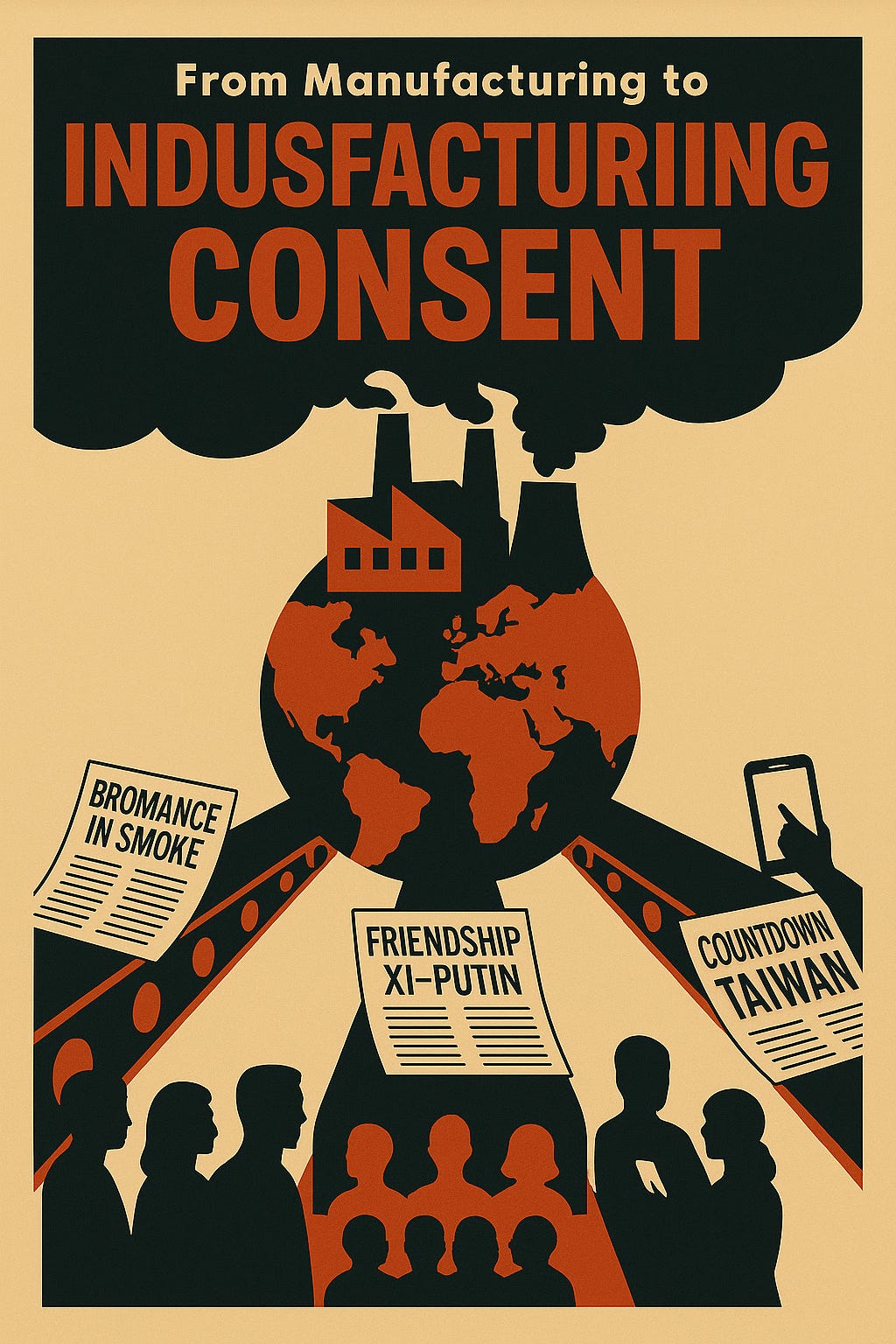
In 1988, Chomsky and Herman showed how U.S. media “manufactured consent” during the Vietnam War: atrocities reframed as “mistakes,” imperial strategy diluted into a tale of accidents and personalities. Designed for a domestic audience, that model has scaled up. Call today’s regime Indusfacturing Consent: the same raw event processed in series, released as tailored storylines for different opinion markets.
A recent example makes it plain. On September 2, 2025, Ian Hall’s piece appears on The Conversation with a restrained headline (Donald Trump was once India’s best friend…). Hours later, the very same text tops Asia Times as a melodrama (Why the Trump–Modi bromance went up in smoke). The strategic backdrop — Modi front-row at the SCO summit — vanishes. One input, two outputs: the narrative assembly line at work.
Le Monde mirrors the move in its September 2 print edition: the SCO becomes “the friendship between Xi and Putin.” India’s centrality and the multipolar shift are eclipsed by a reassuring interpersonal story. The slide is systematic: from structure to psychology.
Beyond wire copy, this global factory standardizes modules — bromance, old friendship, countdown, war drums — and applies them across tech, security, and diplomacy. We have moved from a supplier model to a conversion chain: events turned into differentiated narrative products. In the West, personalization anesthetizes; in Asia, Western actors are ridiculed; in Europe, an anxious hum sets the tone.
Europe’s “war drums” are a case in point. Whether escalation is real or not, the media function is saturation: a cadence that drowns out deindustrialization, energy dependence, political fractures. Sound overwhelms sense.
The generational contrast is telling. In 1968, American youth answered the Vietnam/media dissonance with mobilization and counterculture. In 2025, faced with Gaza, the SCO, or U.S.–India cast as bromance, the dominant response is exhaustion: skepticism, withdrawal. The narrative factory no longer seeks only persuasion; it drains critical energy.
From manu to indu: that is the shift. Manufacturing consent produced a single national storyline; Indusfacturing Consent delivers multiple versions of the same fact, tuned by region. West: anesthetic. Asia: derision. Europe: anxiety. The aim is not a unified consent but the assignment of the storyline that best neutralizes structural thought.
Conclusion: events are real — Trump fumes, Modi maneuvers, Xi and Putin meet — yet their narration rolls off a planetary line. To understand, stop listening to the soap opera and hear the factory hum. Our task is not only to debunk falsehoods but to decode Indusfacturing Consent: the industrialized narrative that erases structures and delivers each public its made-to-measure illusion.
NB. “Indusfacturing Consent” is a neologism meant to mark the shift from national consent-making to a global, differentiated industrialization of narratives.
Sources
· Noam Chomsky & Edward S. Herman, Manufacturing Consent (Pantheon, 1988).
· Ian Hall, Donald Trump was once India’s best friend. How did it all go wrong?, The Conversation, Sept 2, 2025.
· Ian Hall, Why the Trump–Modi bromance went up in smoke, Asia Times, Sept 2, 2025.
· Le Monde, print edition, Sept 2, 2025: SCO headlined “the friendship between Xi and Putin.”