
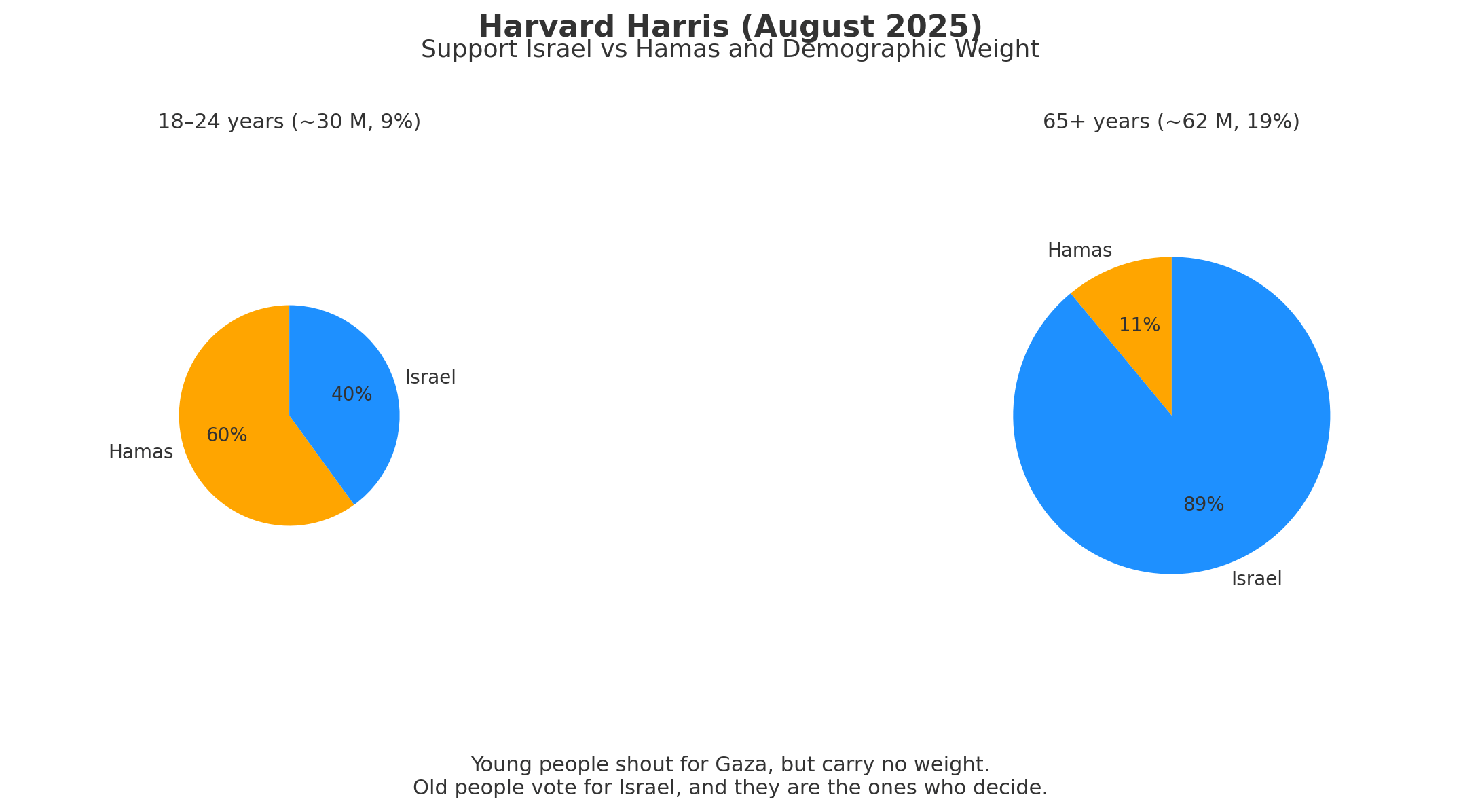
The latest Harvard Harris poll (August 2025) produced a shocking figure: 60% of Americans aged 18 to 24 say they support Hamas rather than Israel when asked which side they back the most. All other age groups remain overwhelmingly pro-Israel—up to 89% among those 65 and older.
The statistic is authentic, confirmed by the official Harvard CAPS/Harris data. But to interpret it properly, we need to put it in context: a summer of 2025 marked by the UN’s official recognition of a famine in Gaza on August 22, more than 62,000 Palestinian deaths since October 7, 2023, and a President Trump openly selling bombs and bulldozers to Israel while speaking of deportations to Egypt and Jordan.
This poll doesn’t mean Generation Z “loves” Hamas. In the same survey, 63% of young respondents disapproved of Hamas’s actions. But 71% disapproved of Israel’s actions. Their shift expresses less active sympathy than a visceral rejection of Israeli conduct. The raw images from Gaza, streaming continuously on TikTok, fuel a sense of witnessing genocide in real time.
At the opposite end, seniors remain anchored in the old founding narrative: Israel as the West’s bulwark, heir to the Holocaust, natural ally of the United States. For them, today’s atrocities don’t contradict the story—they continue it. This is driven by historical memory, decades of desensitization to war, information filtered through traditional television, and above all the fear of chaos: the elderly prefer stability and states, even at the cost of looking away from horror.
What makes this divide even crueler is demographics. Americans aged 18–24 number only about 30 million—roughly 9% of the population. Those 65 and over number 62 million, about 19%—more than double. And seniors turn out to vote at rates above 70%, compared to less than 50% for the young.
The result: the youth may flood social media with pro-Palestinian slogans, but electorally they remain a minority and underrepresented. The ballot box mechanically gives the edge to the elderly—and with it, to pro-Israel policy.
Two pie charts make the point: the youth’s is redder (pro-Hamas) but smaller; the elderly’s is bluer (pro-Israel) and twice as wide. Morally, the rising generation revolts; politically, it carries little weight.
One might think this divide cuts across the parties. But in reality, on the essentials, Democrats and Republicans vote the same way: military budgets, arms shipments, resolutions of support. A few progressive lawmakers (AOC, Tlaib, Omar…) denounce Israel strongly, but they often end up voting for packages that include armaments.
Young people aren’t fooled: they see both institutional camps applying the same underlying line. Hence their political disenchantment: they stop voting, convinced the system is locked. The old, meanwhile, continue to vote massively, because they still believe in the system—they lived in a world where the democratic illusion functioned, where their voice seemed to count.
This asymmetry explains the current situation: a youth radicalized by Gaza but absent from the ballot box, facing a senior bloc that validates through its vote the continuity of support for Israel.
That’s why Trump, even though overall opinion is shifting (60% of Americans oppose new arms deliveries to Israel, 50% say Israel is committing genocide), can act as if nothing had changed. The system rests on seniors, who vote, who still believe in the electoral process, and who maintain their loyalty to Israel.
The youth experience history differently: they see famine, bombings, bodies. But they know they are a minority and politically powerless. Hence their retreat from the ballot box and their over-activity in the symbolic sphere—social media, protests, campus actions. They become the moral conscience of a country whose foreign policy is fixed by their grandparents’ generation.
The “60% pro-Hamas” figure among 18–24-year-olds is not an aberration but the symptom of a generational and moral shift. It reveals an America where two realities coexist:
The young: saturated with raw images, outraged by atrocity, disillusioned with politics, in rupture with the dominant narrative.
The old: rooted in the memory of Israel as victim, faithful to a system that still gives them power, and therefore guardians of the status quo.
Between these two worlds, there is a collision. The streets and networks are indignant; the ballot box locks tight. And meanwhile, the bombs keep falling on Gaza.
Sources :
Harvard CAPS/Harris Poll (August 2025) – full results (Zip 3 Mo contenant 3 PDF) :
https://harvardharrispoll.com…Times of Israel – Luke Tress – August 28, 2025 :
https://www.timesofisrael.com/majority-of-young-us-voters-back-hamas-over-israel-new-poll-showsQuinnipiac University Poll – August 27, 2025 (support drops for u.s. military aid to israel as 50% think israel is committing genocide in gaza, PDF) :
https://poll.qu.edu/images/polling/us/us08272025_ubru23.pdfPew Research Center – April 2025 (Poll: Most young Americans think Israel should be ‘ended and given to Hamas’)
https://www.timesofisrael.com/poll-most-young-americans-back-ending-israel-many-find-jewish-genocide-calls-okayUN/IPC Report – August 15, 2025 – Gaza Strip: Acute Malnutrition for 1 July - 15 August 2025 and Projection for 16 August - 30 September 2025
https://www.ipcinfo.org/ipc-country-analysis/details-map/en/c/1159698/?iso3=PSEOCHA (UN Office for the Coordination of Humanitarian Affairs – Palestine):