
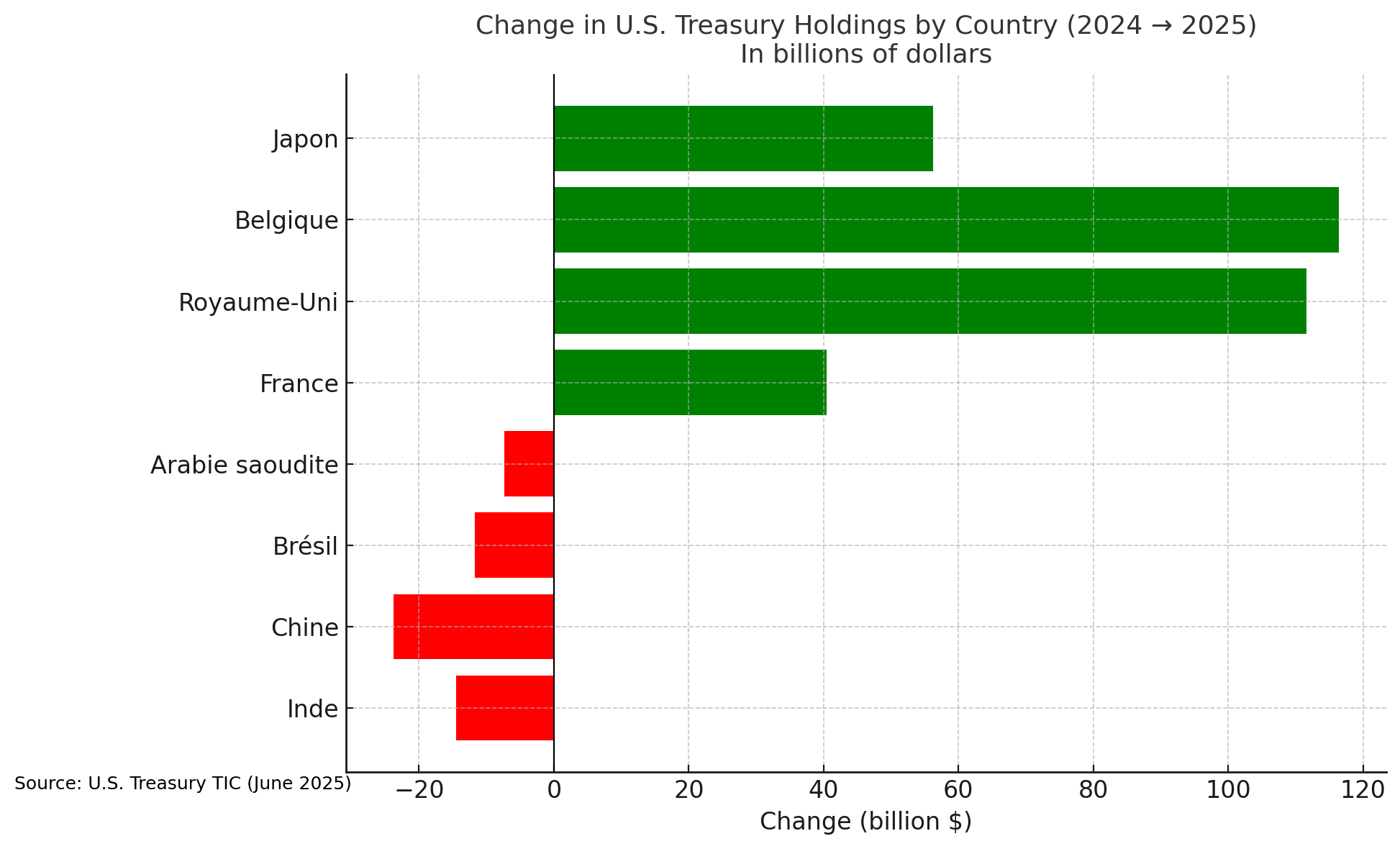
In June 2025, the U.S. Treasury released its latest statistics on foreign holders of government debt. It is the kind of obscure table that rarely makes headlines — yet it tells an essential story about today’s geopolitics.
The raw facts:
India: down from $242 to $227 billion
China: down from $780 to $756 billion
Brazil and Saudi Arabia: slight decreases
France: up from $334 to $374 billion
United Kingdom and Belgium: sharp increases
Japan: still the top holder ($1,147 billion)
Altogether, foreigners held $9,128 billion in U.S. Treasury bonds (Treasuries) in June 2025, compared with $8,299 billion a year earlier. That is a record high.
The Mirage of “the Global South dumping the dollar”
On Telegram and elsewhere, it is often claimed that the Global South is unloading U.S. debt. That is partly true: India, China, and Saudi Arabia are diversifying into other assets, especially gold. But from a broader view, the total stock of foreign-held U.S. debt is rising.
This is not an exodus — it is a redistribution.
The European Custody Effect
Why do London and Brussels appear as frenzied buyers? Because they act as custodians. Many “British” or “Belgian” Treasuries are in fact held by third parties (Asian or Gulf central banks, investment funds). This statistical distortion is acknowledged by the U.S. Treasury itself.
India: Gold as Insurance
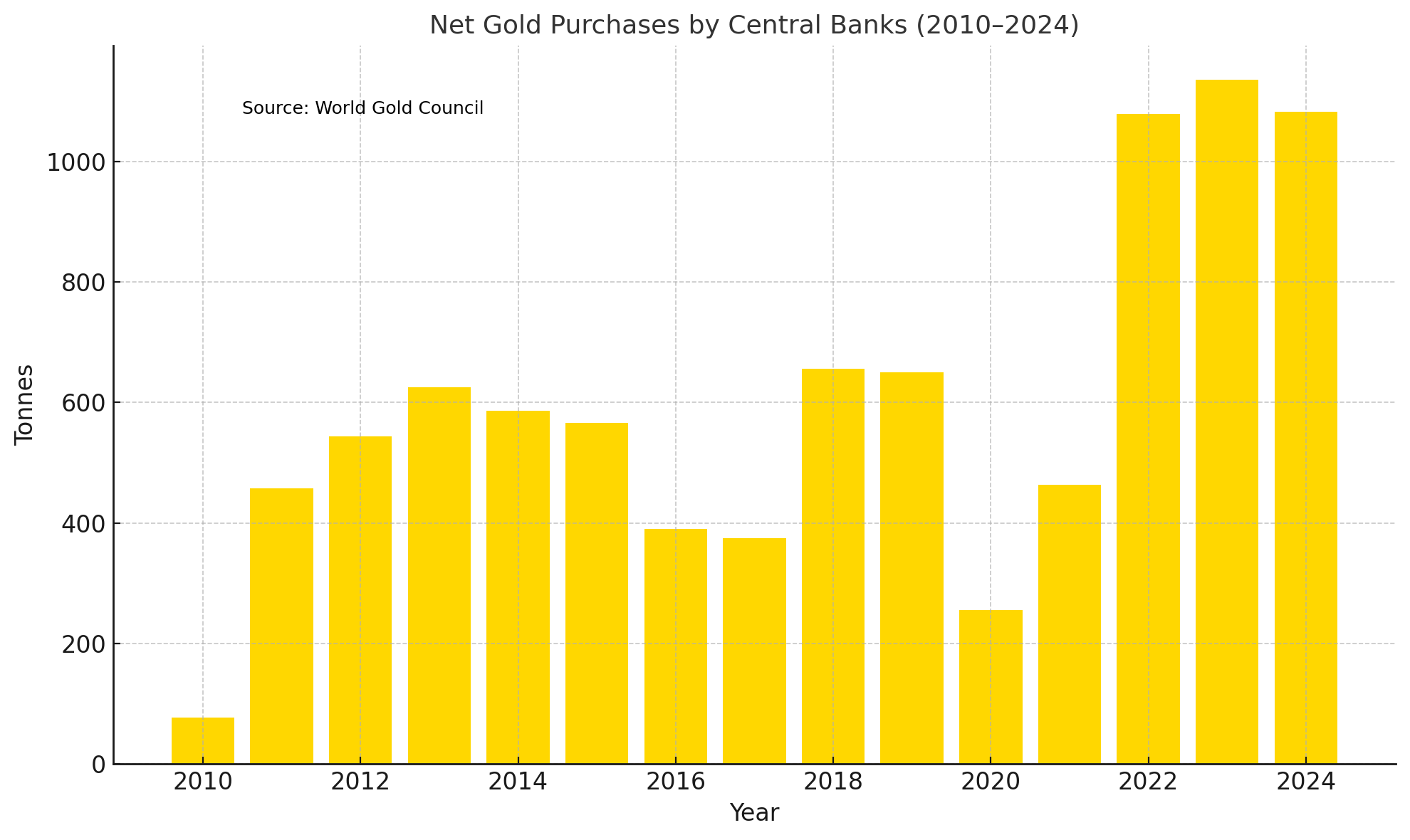
India illustrates the deeper trend. It is slowly reducing its Treasuries and buying more gold. This is not ideological rupture but prudence: gold cannot be sanctioned, remains liquid, and shields against dollar volatility.
China: Adjustment, not rupture
China has been gradually reducing its Treasury holdings, but it remains a major holder and continues to invest in other segments of the U.S. market — such as federal agency bonds and mortgage-backed securities — while also diversifying custody through Hong Kong and other financial hubs. This is an adjustment, not an exit.
And France?
Often overlooked, France is actually a net buyer. Its holdings rose from $334 to $374 billion in one year. Paris thus joins the U.K., Belgium, and Germany in supporting — directly or indirectly — the financing of Washington.
The Real Trend: Diversification
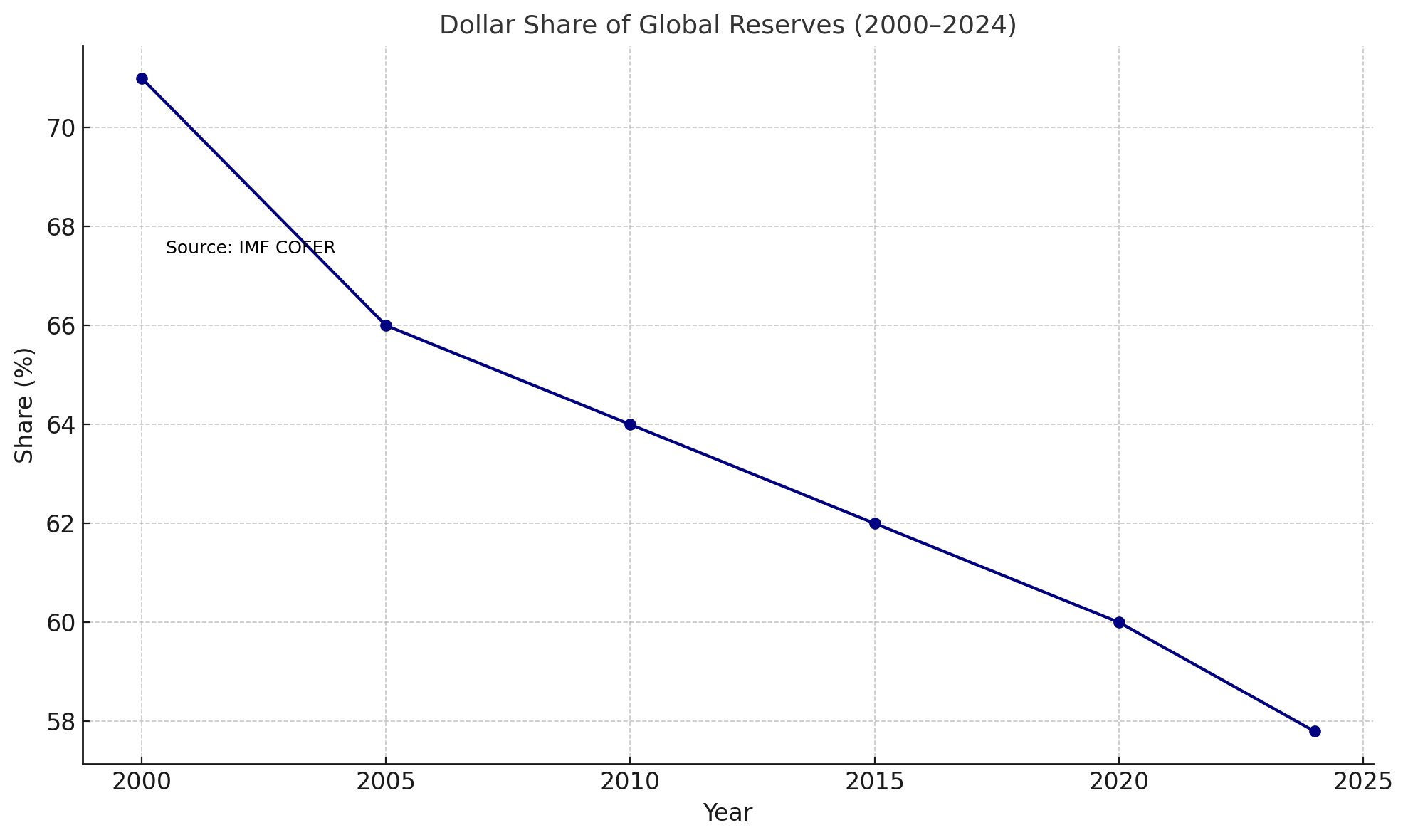
According to IMF COFER data, the dollar’s share of global reserves fell to 57.8% at the end of 2024, down from 65% fifteen years ago. Meanwhile, central banks have been purchasing gold at levels unseen since the Cold War.
This is not collapse, but erosion. The dollar remains the system’s core, but alternatives — yuan, gold, local bonds — are quietly gaining space.
In Plain Terms
Yes, India, China, and Saudi Arabia are trimming their Treasuries.
Yes, gold is back at the center of reserve strategy.
But overall, the world holds more U.S. debt than ever.
Europe (including France) is carrying part of the load, either directly or via custodians.
This is less a spectacular de-dollarization than a careful diversification. The U.S. dollar remains the main house, but more and more countries are keeping a spare key elsewhere — just in case.