

This article is part of the broader context of “BYD-ization,” a concept we have formalized and developed in a series of articles cited in the notes at the very end.
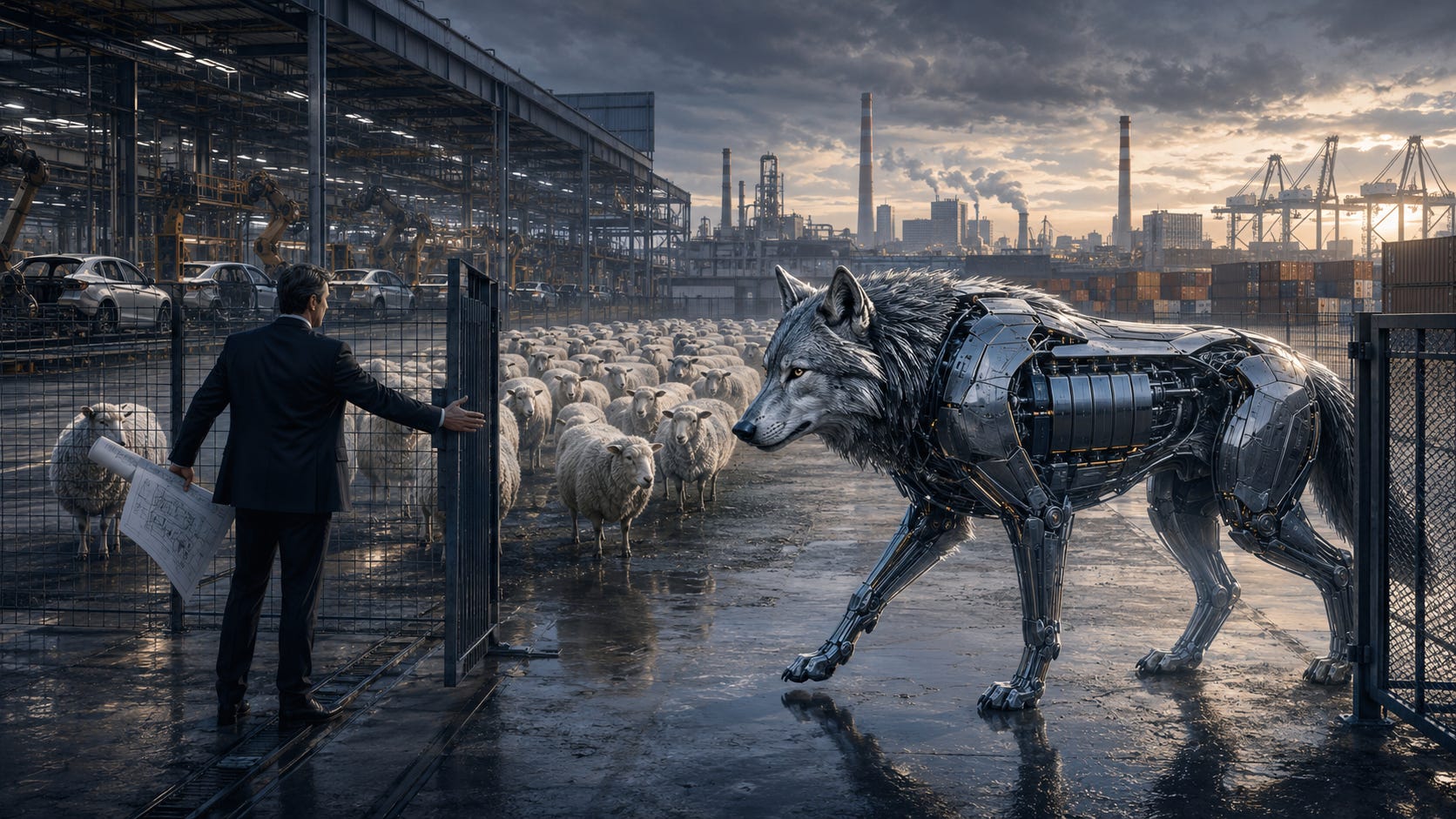
The confession from Detroit
On Thursday, May 21, at Stellantis headquarters in Auburn Hills, near Detroit, CEO Antonio Filosa presented his strategic plan. He announced 60 new models, €60 billion in investment, Big Mac-sized V8 muscle trucks for Trump’s America, and a frugal electric 2CV for Europe. Applause broke out twice.
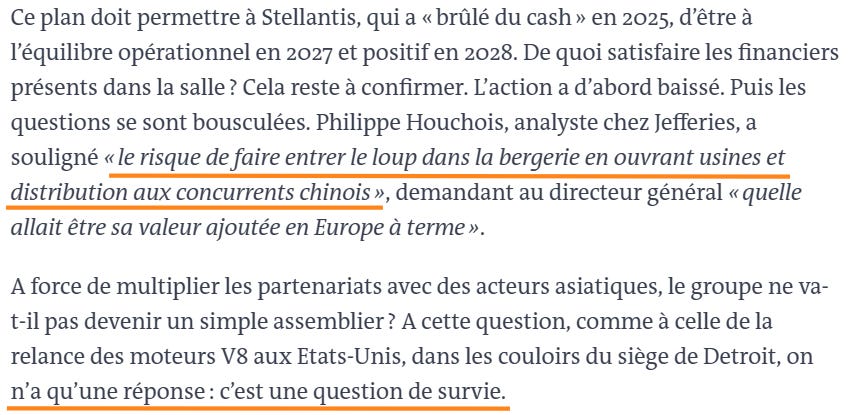
Then came the Q&A session. Philippe Houchois, an analyst at Jefferies (the benchmark US investment bank for the auto sector), as reported by Le Monde correspondent Sophie Fay, highlighted “the risk of letting the wolf into the sheepfold by opening plants and distribution to Chinese competitors,” asking the CEO “what his added value in Europe would be in the long run.” By multiplying partnerships with Asian players, won’t the group end up a mere assembler? To this question, as to the one about reviving V8 engines in the US, the only answer heard in the corridors of Detroit headquarters was: “It’s a matter of survival.”
That sentence is worth more than any strategic plan: Stellantis has no choice but to open its factories to those who threaten its existence. A matter of survival. But survival for whom?
The day before, we were already analysing this masked phase of BYD-ization: Chinese automakers don’t need to enter Europe as declared conquerors. They can come in through underused plants, joint ventures, local content rules, and the survival needs of Western groups.
This is the second rescue attempt for a group that nearly drowned three months earlier. On February 6, Stellantis announced €22.2 billion in exceptional charges as part of its strategic reset. The market reacted brutally: the share price collapsed 25.24% in a single session, to €6.11, setting an all-time record drop (and the worst single-day fall for a major Western automaker since Dieselgate).
In three months, the group went from an existential profit warning to a survival plan. The causes: a massive overestimation of the pace of electrification, a forced U-turn due to Trump’s reversal on clean-vehicle subsidies, and a heavy legacy from the Tavares era (€4.1 billion in provisions for quality defects, thousands of engineers to be hired urgently, malfunctioning plants). That same day, Le Monde ran the headline: “Stellantis: inside a strategic disaster” (« Stellantis, les dessous d’un désastre stratégique »). The plan presented on Thursday is the response to that disaster.
The shepherd and the sheep
Stellantis’s plan draws a clear line between two categories.
On one side, the shepherd: the group’s management, its shareholders, its 14 brands kept alive, its American margins, its muscle trucks still roaring. The plan earmarks 60% of product investment for the US. The group’s centre of gravity has shifted. Europe, once the group’s largest component, is no longer the strategic heart; it is the adjustment variable.
On the other side, the sheep: the European plants, the workers in Poissy, Rennes, Pomigliano, the subcontractors, the employment catchment areas. The plan announces a capacity reduction of 800,000 vehicles in Europe. 800,000 fewer cars means lines being shut, teams being cut, sites being shared with Chinese automakers to fill whatever can still be filled.
You don’t shrink the flock by 800,000 units when you’re protecting the sheep. You do it when you’re preparing the slaughterhouse.
Management language will say “capacity utilisation,” “partnerships,” “localisation,” “regional autonomy.” The reality is that Stellantis’s European auto operations have too many factories, not enough desirable models, not enough margin, and now need Chinese competitors to keep the assembly lines from stopping.
Rennes, new gateway for BYD-ization
The case of the Rennes-La Janais (France) plant perfectly illustrates this shift.
Stellantis wants to assemble Dongfeng’s new energy vehicles there. The factory, which currently builds the Citroën C5 Aircross, lacks a second model and has just experienced short-time working. On paper, Dongfeng’s arrival can therefore be presented as good news: a busy line, reassured employees, a site that stays open.
But the joint statement says Stellantis and Dongfeng are considering a dedicated European joint venture for the sale, distribution, production, purchasing and engineering of Dongfeng’s new energy vehicles. The Voyah brand, created by Dongfeng for the premium electric segment, could lean on Stellantis’s sales and after-sales network. This is no longer about one assembly line; it’s about access to the European market.
The most important sentence in the statement is that the new entity “would also host joint purchasing and engineering activities, leveraging Dongfeng’s highly competitive Chinese electric vehicle ecosystem.” Behind the words, the shift in value is spelled out in black and white. The walls are European. The network is European. The regulatory passport is European. But the competitive ecosystem is Chinese.
This is where BYD-ization advances under cover. It does not necessarily replace Peugeot, Citroën, Jeep or Opel with visible Chinese brands. It enters the plants, the purchasing, the platforms, the engineering, the components, the software, the methods. It can circulate under familiar logos.
The wolf with two faces
The Chinese partner presents itself with two masks.
The first is reassuring. Leapmotor will produce at Stellantis plants in Spain and Brazil. Dongfeng could assemble electric models in Rennes. Factories keep running, local jobs are preserved, European standards are met. The narrative is well rehearsed: we are not coming to destroy, we are coming to share, invest, and save what can be saved.
The second mask is more troubling. Once the regulatory entry ticket has been obtained, once the partnerships have been signed, what remains? The Chinese bring their platforms, their batteries, their software, their suppliers. Stellantis brings its walls, its distribution networks, its historic brands. Added value inexorably shifts towards the one who controls the technology.
Philippe Houchois asked that question precisely because he sees the risk: by constantly multiplying partnerships with Asian players, won’t Stellantis become a simple assembler?
Two industrial philosophies, two outcomes
This face-off between Stellantis and Chinese automakers is not just a competition. It is also the clash of two radically opposed industrial philosophies.
Stellantis was born in 2021, five years ago, from the merger of Fiat-Chrysler and PSA. Its explicit goal was to share components, engineering, purchasing and platforms across different brands. The aim was to optimise margins by cutting costs, without touching the structure. To protect the shepherd, in other words. The reasoning was financial before it was industrial.
- A logic of sharing costs that also shares responsibility
The system was designed to pool costs. It also pools defects. When an engine is used by six or eight brands, who is responsible for its design, its calibration, its long-term reliability? No one—or no one clearly identifiable to the customer. The group’s repeated technical woes are the concrete result. First, the PureTech engine, whose failures led in 2025 to a lawsuit for aggravated deception. Then, the airbags. And now the new Turbo 100 engine, successor to the PureTech, which has been the subject of a massive recall since March 2026 due to fire risk: more than 211,000 vehicles affected in France, spread across eight brands—Peugeot, Citroën, DS, Opel, Lancia, Fiat, Jeep, Alfa Romeo. On top of that, a recall for power steering failure on three brands, fuel leaks on the BlueHDi diesel, water pump gear defects. Each problem, multiplied by the number of brands sharing the same component, becomes an industrial crisis on a grand scale.
The promise of industrial rationalisation turns against itself: less technical diversity also means less compartmentalisation of risk. What was supposed to make the group more efficient makes it more vulnerable.
- China, or selection by bloodbath
In China, the 2010–2020 decade followed the opposite logic. Instead of concentrating, Beijing encouraged proliferation: hundreds of start-ups, dozens of electric manufacturers, fierce competition with no lasting protection for established champions. This bloodbath destroyed thousands of companies, eliminated the weakest, compressed cycles, forced vertical integration.
Those that emerged alive—BYD, Geely, Leapmotor, Xpeng, NIO, Li Auto—are not shared groups born of a merger of convenience. They are survivors of an accelerated Darwinian selection. They master their components, their software, their supply chains, or know how to organise them at great speed, because they had to learn under pressure.
The result is visible: cheaper batteries, fast platforms, embedded software, driver assistance, connected cabins, massive exports, and the ability to localise production when tariffs demand it.
BYD-ization is not the harmonious triumph of a national champion. It is the brutal outcome of a domestic market used as an industrial boxing ring. The survivors now arrive in Europe with the scars and the weapons of that war.
- DS, Lancia, and the reverse gear (after disengaging)
The height of the 2021 strategy: DS and Lancia, elevated as symbols of Stellantis’s rediscovered premium ambition, are now relegated under the wing of Citroën and Fiat, with no new launches planned. Five years after the merger, the two brands Carlos Tavares presented as the spearheads of moving upmarket are being used as adjustment variables.
DS is sent back to Citroën, from which it was supposed to break free. Lancia returns to the orbit of Fiat, its industrial and emotional origin. The great global merger of 2021, meant to allow fourteen brands to conquer the planet through pooling, results in a retreat into heritage.
Pooling did not create European luxury. It drowned the brands in a portfolio without priorities.
Meanwhile, China did not need to resurrect myths. It produced models, batteries, software, interfaces, prices, volumes, and then let the market sort them out.
Stellantis is an archetype, not an exception
Stellantis is not an isolated case. Volkswagen is leaning on Xpeng and Horizon Robotics. Nissan works with Dongfeng and Momenta. Renault relies on Geely, notably in Brazil and South Korea. Ford has left behind sites that the Chinese can take over. Volkswagen itself acknowledges overcapacity in Europe, even when it denies concrete talks with Chinese automakers.
All are following the same logic: open their plants, their catalogues, their platforms or their networks to Chinese partners in order to keep existing, even if the technological architecture of the vehicles becomes partly or entirely Chinese.
BYD-ization advances this way. It does not need to replace Western brands with Chinese brands. It can circulate under the brands customers know, in the factories workers occupy, with the subsidies states grant, under the reassuring vocabulary of local content.
What looks like relocalisation can thus become an import of industrial architecture. What looks like a factory rescue can become a transfer of the centre of gravity.
Last-minute addition. Just as we were finalising this article, on 23 May, Le Monde published a piece with an unusually blunt headline: “Europe’s auto industry abdicates in the face of China” (« L’industrie automobile européenne abdique face à la Chine »).
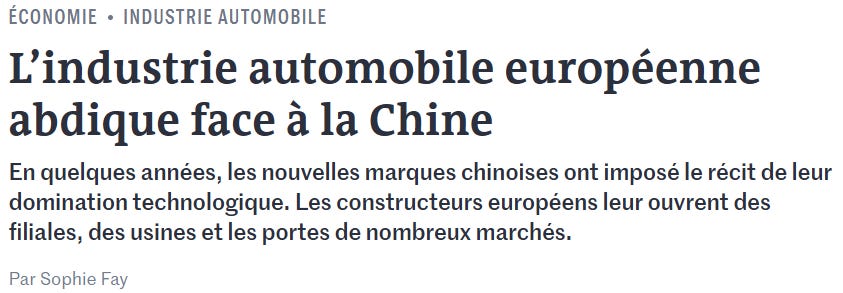
The newspaper describes an “almost total capitulation” by Western and Japanese carmakers in the face of China’s lead in batteries, software, autonomous driving and on-board electronics. But perhaps the most important phrase lies in the subtitle: the new Chinese brands have “imposed the narrative of their technological dominance.” And a brand is, first and foremost, a narrative. For a century, European brands sold more than cars: they sold German reliability, French comfort, Italian sportiness, status prestige. If the narrative of the future now runs through BYD, Leapmotor, Xpeng, Xiaomi or Huawei, then the old European logos are changing status. They remain useful as factories, networks, commercial shopfronts and regulatory passports. But their pulling power is eroding. The cruellest detail concerns Stellantis: in the joint statement with Leapmotor, the Chinese founder Zhu Jiangming praises his group’s “cutting-edge technologies”; Antonio Filosa, for his part, has nothing comparable to say about Stellantis’s. The balance of power is contained in that silence. European brands risk becoming mere old names stuck onto architectures designed elsewhere. Which is to say that those brands, in and of themselves, are already worth very little.
What will remain of the shepherd?
The stock market reception of the Filosa plan has not dispelled the doubts. Financiers see a group that does not choose between combustion and electric, between the US and Europe, between its own technologies and those of its Chinese partners. A group that is cutting European capacity to buy time. A group still trying to figure out how to turn fourteen brands into a coherent strategy.
The sheep have already been sacrificed. The shepherd may survive, but in a form very different from the one touted by the 2021 merger.
Stellantis can remain a seller of cars, a manager of brands, a distributor of technologies designed elsewhere. It can even continue to pay dividends for a few more years, if American margins and Asian partnerships give it the time. But it will no longer be an automaker in the sense its founders understood.
BYD-ization no longer needs to appear as an invasion. It can present itself as a survival solution, occupy European factories, preserve a few visible jobs, use familiar brands, respect local-content thresholds, and then gradually shift value towards Chinese platforms, software, suppliers and standards.
The answer from Detroit—“it’s a matter of survival”—has the merit of clarity. It does not say what will be left at the end.
APPENDIX
The electric 2CV, the Lada of post-industrial Europe?
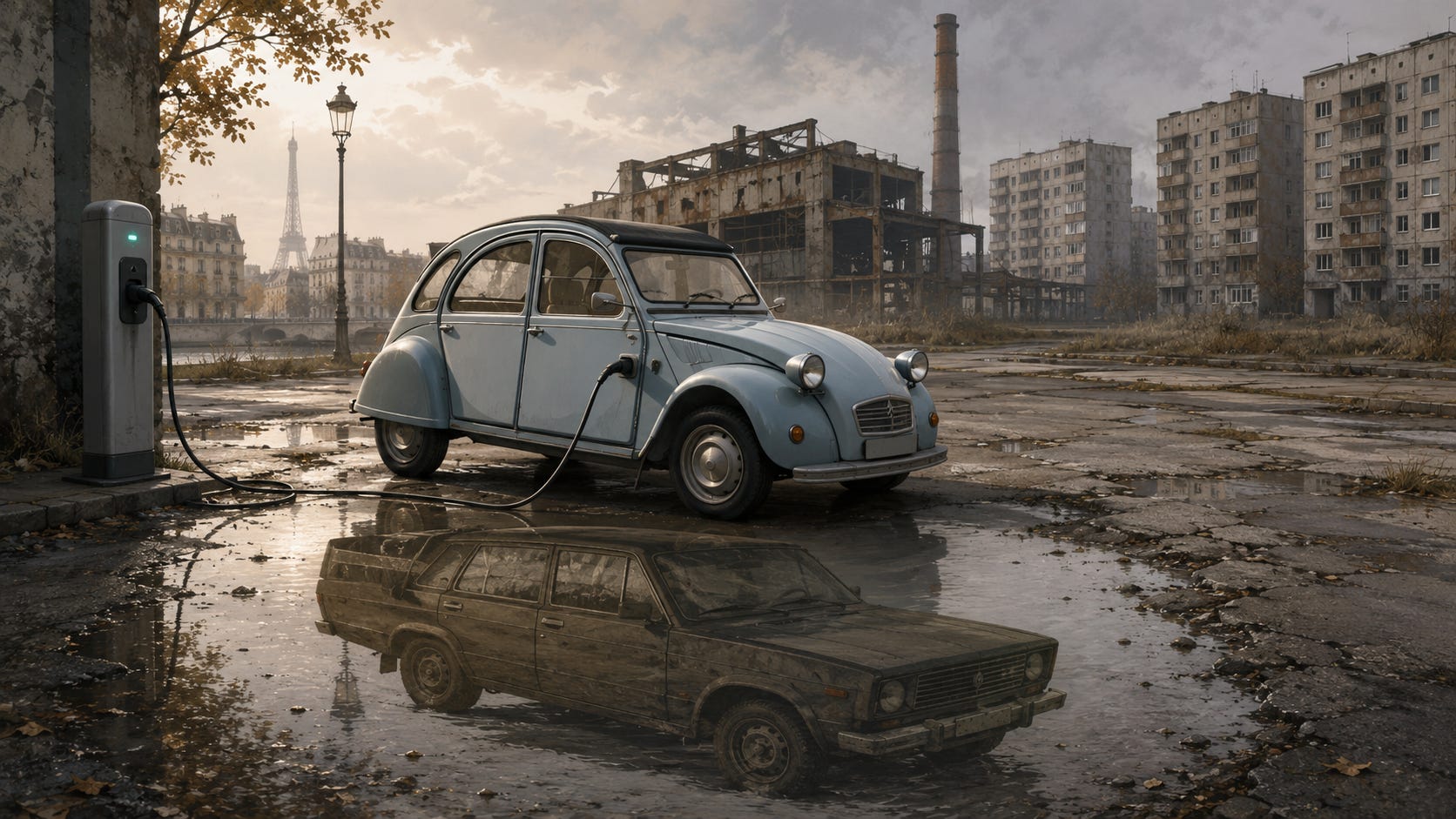
Stellantis’s strategic plan includes the launch of an “e-car” priced under €15,000, directly inspired by the 2CV. Presented as a return to the people’s car roots, this vehicle irresistibly evokes another car, born in a completely different context: the Soviet Lada.
In the Soviet Union of the 1970s, the Lada produced by AVTOVAZ in Togliatti was the answer to an impossible equation: to motorise the population without access to competitive technologies, relying on an ageing Fiat licence and de facto protectionism. The result was a rugged vehicle, mass-produced, with no credible alternative on the domestic market, but which drove on for decades for want of anything better.
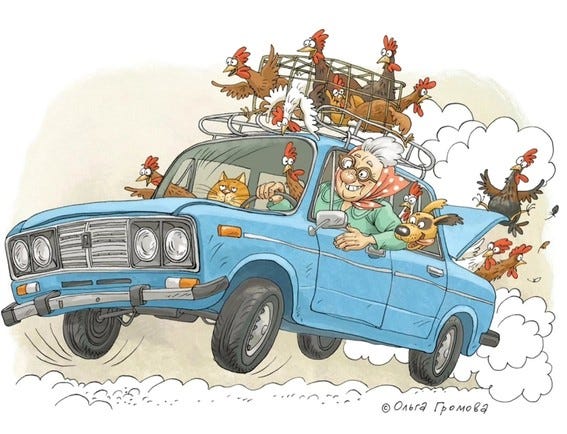
The electric 2CV fulfils a comparable function in the Europe of 2026. It does not aim to compete with Chinese electric saloons on performance, range or embedded software. It is designed to occupy an entry-level segment that Chinese automakers no longer seek to attack head-on, since they are already positioned above it.
This is the factory of consenting downgrading: no longer trying to win the technology race, but offering a frugal car to a market known to be unable to afford anything better.
The parallel extends to the role of protectionism. The USSR protected its market with the Iron Curtain; the European Union does so with punitive tariffs (30.7% on Chinese electric vehicles) and local-content requirements (70% of components to qualify for subsidies). In both cases, the regulatory barrier compensates for the inability to produce at equivalent cost and quality.
Finally, nostalgia serves as a commercial argument. The Lada capitalised on imposed industrial patriotism; the electric 2CV capitalises on the myth of the popular French car. In both cases, memory is sold rather than performance. The Lada was the symbol of a Soviet Union sinking into technological downgrading. The electric 2CV risks becoming the symbol of a Europe that resigns itself to the same fate.
The major difference is that the Lada indeed was virtually indestructible, built to last…
NOTE. Our series of articles on BYD-ization
April 20, 2026. The BYD-ization
Vertical integration, scissor effect, strategic substitution...: the eight mechanisms by which some Chinese companies are redefining global industrial standards.April 27, 2026. The BYD-ization in action: when Volkswagen and Nissan become Chinese
A Nikkei Asia report describes the application manual for the eight mechanisms of BYD-ization, by the very companies it threatens.April 28, 2026. The BYD-ization (continued) – Behind the automobile, the war of software ecosystems
The connected cabin is becoming the Trojan horse through which the Chinese ecosystem (HarmonyOS, AI, cloud) can compete with Apple and Google on their own turf.May 4, 2026. How Europe is Facing BYD-ization
After having devoured the world, old Europe is said to be “devoured” in turn.May 15, 2026. Luxury No Longer Roars. It Computes
The Maextro S800 looks like someone threw a Mercedes-Maybach, a Rolls-Royce, and a Porsche into a blender with a high-end smartphone.
May 16, 2026. Huawei No Longer Sells Only Luxury Cars. It Sells the Mine of the Future
And it’s the exact same core software running both!May 23, 2026. BYD-ization. Stellantis lets the wolf into the sheepfold… as a matter of survival
Survival for whom? For the shepherd, perhaps, but not for the sheep.
Our other articles related to BYD-ization:
April 18, 2026. DeepSeek V4 on Chinese Silicon (Huawei): A Signal for Asia, a Warning for Nvidia
Behind DeepSeek’s performance, an entire East Asian ecosystem is emerging, from Chinese inference to the sovereign ambitions of Japan, Korea, and ASEAN.May 5, 2026. China’s auto bloodbath rages on, by Han Feizi
As China’s EV makers savage each other in bloodlust competition, US, Japanese and German makers should just wave the white flag.May 21, 2026. The BYD-ization is advancing under the radar: European zombie factories, a passport to Chinese industry
Tactic for dodging tariffs and easing trade tensions could raise costs, compliance risks.
All our publications are free and Copyleft. They may be republished, in whole or in part, under following conditions:
→ keeping the title and content
(text, images, editor’s or translator’s notes, boxes)
→ crediting the author(s) and/or translator(s)
→ inserting a clickable link to the source.
Any monetization or commercial use of these publications is prohibited and will be subject to legal action.